
Production Readiness Checklist for Web Applications: The 2026 Guide
July 2, 2026
Production readiness is not a single sign-off or a last-minute checklist before launch. For modern web applications, it is the discipline of proving that a system can operate safely, predictably, and recoverably under real-world conditions. That means more than “the feature works on my machine.” It means authentication is robust, failures are contained, telemetry is usable, deployments are reversible, data is protected, and the team knows exactly what to do when something breaks.
In 2026, production readiness is even more critical because web applications are expected to be always on, globally accessible, and continuously changing. Teams ship faster, infrastructures are more distributed, attack surfaces are broader, and user expectations are higher than ever. A production-ready app is one that has been designed not only for correctness, but also for resilience, observability, performance, and operational accountability.
The best way to think about production readiness is as a set of engineering guarantees. Each layer of the stack should answer a specific question: Can the app resist common attacks? Can it survive partial outages? Can the team detect problems before users do? Can it scale without guesswork? Can it be rolled back safely? Can data loss be recovered from? Can the team support the system at 3 a.m. if needed?

This guide breaks production readiness into ten practical areas that teams should verify before launch and keep revisiting after launch. It is written for developers, engineers, and technical leaders who need a rigorous framework for shipping web applications in production with confidence.
1. Introduction: What Production Readiness Means for Modern Web Applications
Production readiness means the application is fit for real users, real traffic, real failures, and real operational constraints. It is the difference between a feature-complete product and a dependable service. A system can pass functional QA and still fail in production because of weak secrets handling, missing alerts, unstable database queries, or an incomplete rollback strategy. Production readiness closes that gap.
Modern web applications are rarely monoliths with a single deployment target. They often combine frontend apps, backend APIs, background workers, caches, message queues, third-party integrations, and cloud-managed services. This architecture increases flexibility, but it also introduces operational coupling. A “working” feature may depend on five or six components behaving correctly at once. Production readiness is the practice of validating those dependencies and the failure modes between them.
A production-ready web application should have documented expectations for availability, performance, error budgets, and incident handling. It should also have explicit assumptions about what happens when an external service degrades, when the database becomes slow, when a deploy fails, or when a sudden traffic spike arrives. Teams should treat these scenarios as design inputs, not edge cases.
Just as important, production readiness is a team capability, not only a technical property. The product, engineering, security, QA, and operations functions must all understand what “ready” means. If ownership is unclear, observability is weak, or support processes are informal, the application may be technically sound but operationally fragile. A useful readiness process forces those dependencies into the open.
The most effective teams treat production readiness as continuous. They do not “check the box” once and move on. Instead, they maintain living standards, automate checks where possible, and review readiness at major milestones: new launches, architecture changes, scale events, security changes, and incident learnings.
2. Security Baseline: Authentication, Authorization, Secrets, Headers, and OWASP ASVS Alignment
Security is one of the fastest ways to lose production trust, so a readiness checklist must start here. The baseline requirement is simple: the application should enforce strong identity, strict access control, safe secret management, hardened browser behavior, and verifiable security requirements. OWASP ASVS is widely used as a structured verification standard for web applications, and current OWASP materials point teams to the latest stable ASVS 5.0 release. (github.com)
Authentication should be centralized, enforceable, and resistant to common abuse. That means secure password storage if passwords exist, multi-factor authentication for sensitive users or actions, session expiration, token rotation where relevant, and protection against brute force and credential stuffing. Authentication flows should also be tested for edge cases such as password reset abuse, session fixation, account enumeration, and insecure “magic link” behavior. A production-ready system should make it hard to guess whether an account exists, hard to hijack a session, and easy to revoke access when needed.
Authorization is equally important. Many applications authenticate users correctly but fail at authorization boundaries. Every request path should enforce server-side authorization checks, not rely on frontend gates or obscured URLs. Role-based access control, attribute-based access control, tenant isolation, and object-level permissions should be validated explicitly. If your application is multi-tenant, verify that no query, cache key, export path, webhook handler, or background job can leak data across tenants.
Secrets management must be handled with discipline. API keys, database passwords, private certificates, signing keys, and webhook secrets should never live in source control or be embedded in client-side code. They should be stored in a secure secret manager, rotated on a schedule, and scoped as narrowly as possible. Production readiness also means verifying that secrets do not leak into logs, crash dumps, build artifacts, browser bundles, or support tickets.
Browser and transport security headers are a basic production control, not an optional hardening step. At minimum, validate TLS everywhere, HSTS for HTTPS-only applications, a well-defined Content Security Policy, proper CORS rules, X-Content-Type-Options, Referrer-Policy, and frame protections where appropriate. These headers reduce the blast radius of common web attacks and prevent accidental exposure caused by misconfigured clients or intermediaries.
Alignment with OWASP ASVS is valuable because it turns “be secure” into testable requirements. Teams can map application controls to ASVS sections such as authentication, session management, access control, validation, and logging. That mapping makes security review more repeatable and helps development teams understand what “done” means for secure delivery. In practice, the goal is not to comply with a document for its own sake, but to translate recognized security requirements into concrete application behavior.
3. Reliability Engineering: Error Handling, Retries, Graceful Degradation, and Resilience Patterns
Reliability engineering is about ensuring that partial failures do not become total outages. A production-ready web application should assume that dependencies fail, networks flap, resources saturate, and transient errors will happen. The question is not whether failures occur, but how the system behaves when they do.
Error handling should be deliberate and user-safe. Internal errors must be captured and classified, while user-facing responses should be actionable and non-technical. Avoid leaking stack traces, internal IDs, SQL fragments, or service topology to end users. Implement consistent error envelopes for APIs, and make sure clients can distinguish between validation failures, authentication errors, rate limits, timeouts, and upstream dependency failures.
Retries are useful, but only when applied carefully. Blind retries can amplify load, worsen outages, and duplicate side effects. Production-ready retry logic should be limited to idempotent operations or protected with idempotency keys. Use exponential backoff with jitter, enforce retry budgets, and fail fast when the error is clearly non-transient. A retry without a timeout is not resilience; it is a hidden denial-of-service pattern against your own infrastructure.
Graceful degradation is often what separates a service that remains useful from one that becomes unavailable. If a recommendation engine fails, the app might still render the checkout page. If analytics is unavailable, the transaction should still complete. If a personalization service is down, the app should fall back to a default experience. The goal is to preserve core user journeys even when secondary features fail. This requires feature boundaries that are explicit and independently recoverable.
Resilience patterns should be part of the architecture, not patched in later. Circuit breakers, bulkheads, queues, backpressure, request timeouts, stale-cache serving, hedged requests, and fail-open or fail-closed decisions all need to be intentional. Systems that integrate with third parties should isolate those calls and avoid allowing external latency to dominate critical request paths. For asynchronous processing, design jobs so that they can be retried safely and resumed after interruption.
A production-ready service also needs dependency awareness. Know which components are critical path and which are optional. Define the behavior when a cache is cold, a feature flag service is unavailable, or a downstream API returns partial data. If you cannot answer those questions in advance, production will answer them for you under stress.
4. Observability and Alerting: Logs, Metrics, Traces, SLOs, and Incident Response Readiness
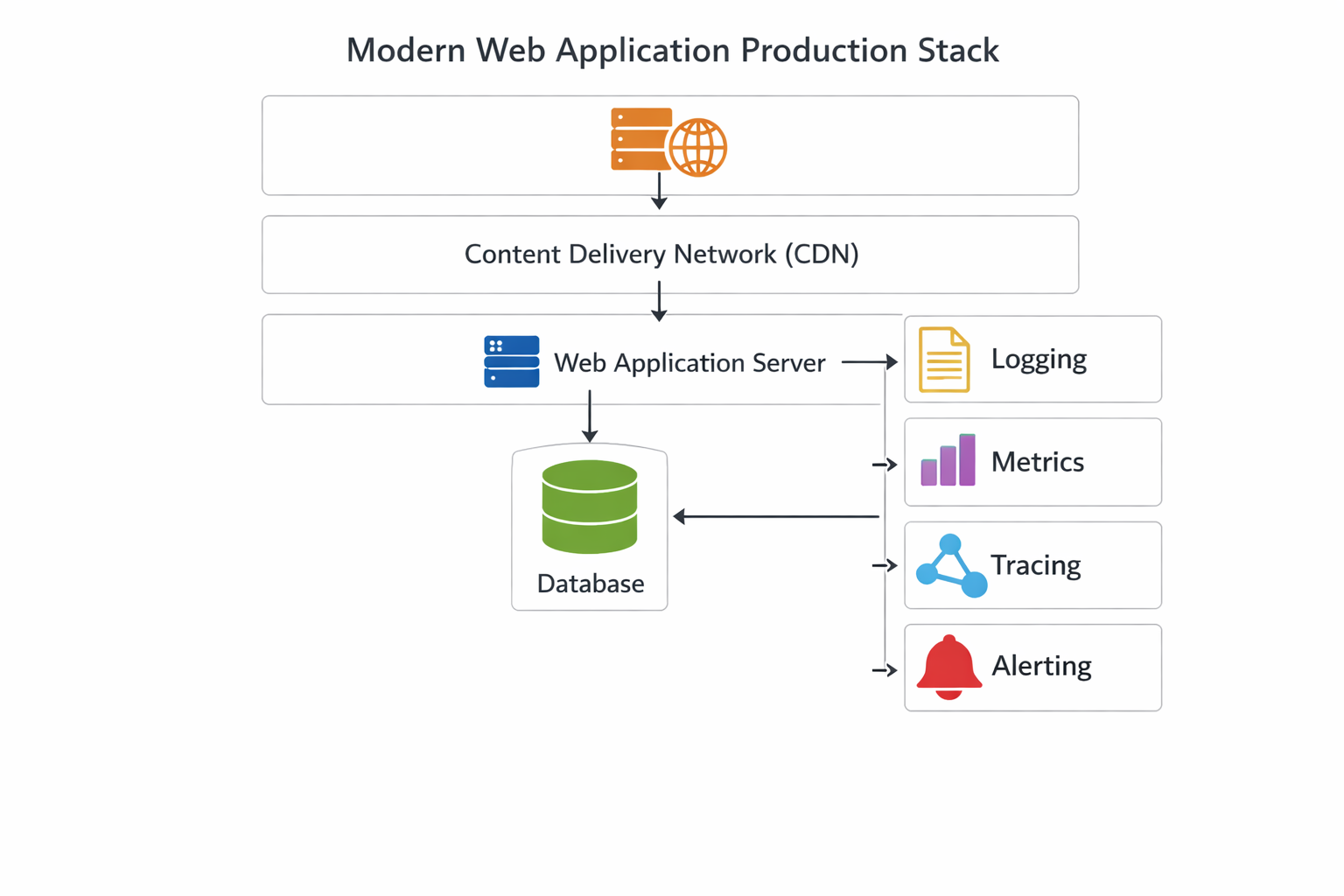
Observability is what makes a production system understandable. Without it, the team is guessing during incidents, which slows recovery and increases user impact. At a minimum, production readiness requires usable logs, meaningful metrics, distributed traces where applicable, and alerting that reflects user-facing reliability rather than internal noise. Google’s SRE guidance emphasizes SLO-driven alerting and incident management as core operational practices. (sre.google)
Logs should be structured, correlated, and privacy-aware. Use consistent field names, request identifiers, user/session correlation where permitted, and clear severity levels. Logs should answer operational questions quickly: what happened, where, when, for whom, and with what downstream effects. They should not be verbose dumps of every variable or stack trace. In production, log quality matters more than log quantity.
Metrics should reflect service health and user experience. Track latency percentiles, request success rates, throughput, saturation indicators, queue depth, error rates, and dependency health. Avoid over-relying on infrastructure metrics alone. CPU usage and memory pressure matter, but they do not tell you whether users can log in, complete checkout, or export reports. Metrics should be chosen from the perspective of the product journey.
Traces are essential in distributed systems because they reveal where latency and failures originate across service boundaries. If the application involves frontend, backend, and multiple upstream or downstream services, traces help distinguish a slow database query from a slow third-party API or a frontend retry loop. Production readiness includes knowing which spans must be instrumented and which request paths need propagation across service boundaries.
SLOs translate technical signals into business-relevant reliability targets. They define what level of availability, latency, or correctness is acceptable over time. A readiness review should confirm that SLOs exist for the most important user journeys and that alerts are tied to meaningful symptoms rather than every minor anomaly. Good alerts are actionable, prioritized, and few enough to trust. Bad alerts create fatigue and hide real incidents.
Incident response readiness should also be tested before launch. That means defining severity levels, escalation paths, communication channels, ownership, and post-incident review expectations. A team should know who is on point, who communicates with stakeholders, who validates recovery, and who closes the loop afterward. Incident response becomes much more effective when the team has practiced it, even in tabletop form.
5. Performance and Scalability: Load Testing, Caching, Database Tuning, CDN Strategy, and Capacity Planning
Performance is not only about speed. It is about predictable responsiveness under expected and unexpected load. A production-ready web application must prove that it can handle typical traffic, burst traffic, slow downstreams, and growth over time without collapsing. Performance work should cover the whole delivery path, from browser rendering to origin servers to databases and edge caching.
Load testing is the first validation step. Test beyond average traffic and toward the realistic upper bound of demand, including spike behavior, concurrency, and failure conditions. Use tests that reflect actual user behavior rather than synthetic perfection. For example, a login-heavy test should include authentication, session creation, dashboard rendering, and database lookups in one workflow. Measure latency percentiles, error rates, resource saturation, queue buildup, and recovery after the load ends.
Caching should be designed intentionally at multiple layers. Browser caching, CDN caching, reverse proxy caching, application memoization, and database query caching each solve different problems. The readiness question is whether cache invalidation, TTLs, and stale data policies are understood. If data freshness matters, define how long stale content is acceptable and how cache misses behave. If a cache fails, the system should degrade gracefully rather than amplify the load onto the origin.
Database tuning is often the highest leverage performance work in production. Review query plans, index coverage, connection pooling, transaction scope, lock contention, and read/write separation where applicable. A query that is acceptable at small scale may become unusable once data grows. Production readiness means identifying the top traffic paths, the most expensive queries, and the operational limits of the current schema. It also means ensuring migrations are safe, reversible, and compatible with live traffic.
CDN strategy should be tied to user geography and asset type. Static assets, images, scripts, stylesheets, and downloadable files often benefit from edge delivery, compression, and versioned caching. Dynamic content may still be accelerated through edge routing or partial caching, depending on the platform. Readiness includes confirming cache headers, purge behavior, origin failover assumptions, and how the app behaves when the CDN is degraded.
Capacity planning closes the loop. Teams should know current headroom, expected growth, cost of scale, and the thresholds that trigger infrastructure changes. That includes storage growth, request volume, database size, cache utilization, queue lag, and third-party rate limit exposure. If the team cannot estimate how the system behaves at 2x or 5x current traffic, it is not production-ready for growth.
6. Deployment and Release Management: CI/CD, Rollback Plans, Feature Flags, and Environment Parity
Deployment is one of the highest-risk moments in the software lifecycle, so production readiness must include release safety. The goal is to make change routine and recoverable. A reliable deployment system reduces human error, allows rapid rollback, and keeps development, staging, and production aligned enough that surprises are rare.
CI/CD pipelines should be automated, gated, and reproducible. Build artifacts should be immutable and promoted through environments rather than rebuilt differently at each stage. The pipeline should run tests, security checks, linting, packaging, and deployment validation in a consistent sequence. Manual steps should be reserved for true approvals or controlled promotions, not for tasks that can be codified.
Rollback planning is mandatory. Every production release should have an explicit rollback strategy, and that strategy should be tested, not imagined. Rollback may mean reverting a deploy, toggling a feature flag, switching traffic, or restoring a prior artifact. The right method depends on architecture, but the key readiness requirement is that the team knows the expected time to recover and the data implications of rollback.
Feature flags are one of the most effective tools for reducing release risk. They allow teams to ship code dark, expose it gradually, and disable it quickly if behavior is unsafe. But flags also create operational complexity. Production readiness should include flag lifecycle management: naming, ownership, expiration, default behavior, and cleanup after release. A flag that lingers forever becomes technical debt and a hidden source of confusion.
Environment parity matters because many deployment failures are really environment mismatches. Production readiness means staging should mirror production in topology, runtime versions, critical dependencies, and configuration patterns as closely as practical. It does not need to be identical in scale, but it should be representative enough to catch drift. Differences in environment variables, package versions, permissions, or cloud configuration are common causes of release failures.
Release management should also cover database changes and backward compatibility. Safe deployments often require expand-and-contract migration patterns, dual reads or writes, and deliberate sequencing between code and schema changes. If deploys require downtime or risky manual coordination, the system is not yet production-ready in a modern sense.
7. Data Protection and Compliance: Backups, Disaster Recovery, Privacy Controls, Retention, and Auditability
Data protection is one of the clearest markers of production maturity. An application may function beautifully in normal conditions and still be unacceptable if it cannot recover lost data, protect private information, or prove what happened to records over time. Production readiness should therefore include backup validation, disaster recovery planning, privacy controls, retention rules, and auditability.
Backups must exist, but more importantly, they must be restorable. Many teams create backups and assume they are sufficient. They are not. A production checklist should verify backup frequency, retention period, encryption, restoration procedures, and test restores. The ability to restore a single table, a single tenant, or an entire environment can be the difference between a brief incident and a major outage.
Disaster recovery should be documented in operational terms. What happens if the primary region fails? What is the recovery time objective? What is the recovery point objective? Which components can fail over automatically, and which require manual intervention? How do DNS, databases, object stores, queues, and secrets behave during a regional event? Production readiness means the team can answer these questions without improvising.
Privacy controls should be built into the application lifecycle. Identify what personal data is collected, where it is stored, how long it is retained, who can access it, and how it is deleted or anonymized when required. Privacy is not just a policy document; it is a system property. A readiness review should confirm that access to sensitive data is restricted, logged, and justified.
Retention rules must be intentional. Keep data only as long as required by business, legal, or compliance needs. This applies to user records, logs, analytics data, backups, and exports. Over-retention increases risk and cost. Under-retention may break supportability or compliance. The right answer depends on context, but the requirement is to define it clearly.
Auditability completes the picture. Sensitive changes, administrative actions, permission grants, data exports, and configuration changes should leave an auditable trail. Audit logs should be tamper-resistant and available to the right teams. If the organization needs to investigate a security issue, a financial dispute, or a regulatory question, the evidence should be available and trustworthy.
8. Operational Readiness: Runbooks, Ownership, Support Model, On-Call, and Change Management
Operational readiness ensures the system can be run by humans under pressure. It is easy to underestimate this category because it is less glamorous than architecture or security, but it is often the difference between a minor incident and a prolonged outage. Production readiness means the team has documented how the service is owned, supported, and changed over time.
Runbooks are essential. They should describe how to detect common failures, what symptoms matter, where to look first, how to mitigate safely, and how to confirm recovery. A good runbook is task-oriented and concise, not a theoretical architecture essay. The most important runbooks cover login failures, elevated latency, deployment rollback, data corruption, queue backlog, certificate expiration, third-party outages, and capacity exhaustion.
Ownership should be explicit. Every service and critical dependency should have a clearly defined owning team, escalation path, and decision-maker for production changes. Ambiguous ownership slows incident response because no one knows who can act. A readiness review should confirm that the service has a primary owner, backups for coverage, and a support path that matches the business’s operating hours.
Support model matters because customer expectations vary. Some systems need business-hours support; others require 24/7 coverage. Production readiness should align the support model with service criticality. It should also define what the support team can do, what requires engineering escalation, and how handoffs occur across time zones or shifts.
On-call readiness is not just about paging people. It includes fatigue management, alert quality, escalation policies, and incident training. Teams should verify that on-call responders have access to the systems, dashboards, documentation, and authority they need to resolve issues. If responders are regularly blocked by missing permissions or unclear procedures, the on-call system is not ready.
Change management ties all of this together. Significant changes should have review, approval, risk assessment, and communication where appropriate. The process should be lightweight enough to avoid bottlenecks but strict enough to prevent accidental outages. Production readiness means change is controlled, visible, and reversible.
9. Quality Assurance Checklist: Functional Testing, Accessibility, Browser/Device Coverage, and Regression Checks
Quality assurance is not a separate phase from production readiness; it is one of its inputs. A system cannot be production-ready if the team has not validated core functionality, critical workflows, and user-facing compatibility across the environments that matter. QA should be focused on real user journeys, not only isolated unit tests.
Functional testing should cover the highest-value paths first. These usually include sign-up, login, password reset, core creation or editing flows, payment or checkout flows, search, export, notifications, and admin actions. Tests should verify not only success cases but also failures: invalid input, expired sessions, partial outages, permission errors, and duplicate submissions. Production readiness means those flows work predictably and fail safely.
Accessibility is a non-negotiable part of quality. A production-ready web application should be tested for keyboard navigation, focus management, semantic structure, contrast, labels, screen-reader compatibility, and error-message clarity. Accessibility problems are not merely usability issues; they can become legal, reputational, and revenue risks. Teams should use automated checks where possible, but manual verification is still necessary for meaningful coverage.
Browser and device coverage should reflect real usage patterns. The app may need to support the latest versions of Chrome, Safari, Firefox, and Edge, plus mobile browsers and responsive layouts on common screen sizes. Production readiness includes verifying that critical interactions behave correctly across those targets, especially for forms, navigation, auth flows, and media rendering.
Regression checks should be automated and tied to release risk. Not every change needs full end-to-end coverage, but every release should validate the system’s critical behaviors. Smoke tests, contract tests, and a small set of high-signal end-to-end checks can catch broken builds before users do. The key is consistency: the same essential workflows should be checked every time.
A practical QA checklist should also include content validation, localization if applicable, and external integration checks. If emails, webhooks, payments, search indexes, analytics tags, or file uploads are part of the user experience, they should be tested under realistic conditions. If QA only validates the app in a controlled sandbox, production will expose the missing edges.
10. Go-Live Review and Post-Launch Monitoring: Launch Criteria, Canary Rollout, and Continuous Improvement
Go-live is not the finish line; it is the beginning of real operational feedback. A strong production readiness process defines launch criteria, rollout strategy, and post-launch monitoring before the release happens. That way, the team can detect issues quickly, reduce blast radius, and improve the system with evidence rather than assumption.
Launch criteria should be explicit and measurable. Before go-live, the team should confirm that essential test suites pass, critical metrics are within threshold, observability is enabled, rollback is available, support coverage is in place, and no blocking security or data issues remain open. If launch decisions are made informally, the team risks shipping with unresolved ambiguity about safety.
Canary rollout is one of the most effective ways to reduce launch risk. Instead of sending all traffic to the new version immediately, route a small percentage first and watch for anomalies in error rate, latency, resource consumption, business conversion, and user reports. If the canary behaves well, expand gradually. If it behaves poorly, stop, investigate, and roll back or fix before wider exposure. The more critical the system, the more valuable this gradual approach becomes.
Post-launch monitoring should be more intensive than steady-state monitoring. The first hours and days after release are when hidden assumptions are most likely to surface. Track business metrics, technical metrics, support tickets, logs, and user feedback closely. Compare behavior against the baseline before release. Pay particular attention to slow regressions that might not trigger immediate alarms but still affect conversion, retention, or operational cost.

Continuous improvement is the final production readiness principle. Every incident, near miss, and launch issue should feed back into the checklist. If a deploy failed because of a schema mismatch, add a migration control. If an alert fired too late, improve the SLO or telemetry. If the support team lacked a runbook, write one. Production readiness is not static; it becomes stronger only when teams learn from what actually happened in production.
Conclusion: A Production-Ready Web Application Is a Managed Risk, Not a Perfect System
Production readiness is about reducing uncertainty to a level the business can accept. No web application is perfect, and no checklist can eliminate every failure. But a well-run engineering organization can make its systems safer, more observable, easier to operate, and faster to recover. That is the real value of a production readiness review.
The strongest teams do not treat readiness as a final gate. They treat it as a living standard that spans design, development, deployment, support, and incident response. Security controls are verified early. Resilience patterns are tested before users depend on them. Telemetry is designed so the team can see what matters. Performance is measured under load. Deployment is reversible. Data is protected. Operations are documented. QA reflects real user journeys. Launches are gradual and monitored.
If you apply the checklist in this guide consistently, production becomes less of a leap and more of a controlled transition. That is the difference between shipping software and operating a reliable service. For modern web applications, that difference is everything.