
How to Stabilize a Multi-Entity ERP Program Before It Unravels
June 22, 2026
A multi-entity ERP launch is rarely “done” at go-live. In fact, the hardest work usually starts the day after the switch flips. The reason is simple: a single ERP instance or coordinated ERP landscape is not just a software implementation. It is a synchronization of legal entities, tax regimes, currencies, approvals, data standards, interfaces, controls, and operating habits that have often evolved independently for years.
When a program spans multiple subsidiaries, business units, countries, or brands, the post-launch environment is structurally fragile. A small master data issue can cascade into invoicing errors, intercompany mismatches, delayed financial close, broken warehouse replenishment, or compliance exposure. Meanwhile, the business expects the new ERP to immediately deliver cleaner reporting, better controls, and lower manual effort. That gap between expectation and operational reality is where many programs begin to unravel.
Stabilization is therefore not a side task. It is a discipline. It requires a command center, strict integration governance, strong decision rights, and an architecture that can absorb complexity without collapsing under it. It also requires a realistic understanding of what multi-entity operations actually demand: not one global process, but a controlled balance of standardization and local variation.
This post explains why multi-entity ERP programs destabilize after go-live, what makes them uniquely complex, and how to build a pragmatic stabilization strategy that restores confidence without freezing the organization. It also outlines a 90-day roadmap for turning a troubled launch into a controlled operating model.
1. Why multi-entity ERP programs fail after the “go-live” moment
Go-live is often treated as the finish line, but in a multi-entity environment it is more accurately the beginning of a high-risk operational phase. The program may have passed testing and cutover, yet still fail because the real-world transaction mix is broader, messier, and less predictable than the test scripts captured. Intercompany transactions, tax edge cases, multi-currency valuation, local statutory reporting, and exception handling all tend to surface only when live business volume starts flowing. The system may be technically “up,” but the operating model can still be unstable.
One common failure pattern is that the implementation team optimized for project completion rather than operational resilience. That means the solution was judged on whether transactions could be processed, not whether they could be processed at scale, under exception conditions, across month-end close, with local audit evidence intact. In a multi-entity deployment, this distinction matters enormously. A process that works for one entity may break when it is replicated across five legal entities with different VAT rules, chart-of-account mappings, banking requirements, and approval hierarchies.
Another issue is organizational exhaustion. By go-live, key subject matter experts are often depleted. They have spent months in design workshops, testing cycles, cutover planning, and training. After launch, they are expected to act as both business operator and defect resolver. That dual role creates bottlenecks. Decisions pile up, tickets accumulate, and operational teams begin improvising workarounds. Once shadow processes start, confidence erodes quickly.
The failure is often not dramatic at first. It appears as missed purchase orders, delayed cash application, duplicate master records, unexplained posting errors, or a gradual extension of the close calendar. Then leadership starts asking whether the ERP is “working,” and the answer becomes politically loaded. Stabilization must therefore be treated as a separate program phase with its own priorities, metrics, and authority. Without that shift, the implementation can quietly degrade into a permanent firefight.

2. The hidden complexity of operating across separate legal entities, currencies, and reporting rules
Multi-entity ERP programs become difficult not because each component is individually hard, but because the dependencies multiply. Legal entities are not merely reporting segments; they are distinct accounting, tax, and control boundaries. They may share suppliers, customers, warehouse networks, or service teams, but they often differ in statutory requirements, signatories, payment processes, local language requirements, and document retention rules. The ERP has to respect these boundaries while still enabling consolidated operations.
Currency complexity is another major destabilizer. A single transaction can involve order currency, invoice currency, functional currency, and group reporting currency. Exchange rates may differ by day, by transaction type, or by accounting policy. Small inconsistencies in rate selection or timing can create reconciliation gaps that are extremely hard to debug after the fact. In a multi-entity program, those gaps often appear as intercompany imbalance, FX variance, or unexplained posting differences between subledger and general ledger.
Reporting rules add another layer of fragility. Management reporting may need standard global dimensions, while statutory reporting needs local chart-of-account mappings, tax boxes, disclosure formats, and jurisdiction-specific documentation. The same underlying transaction may need to be represented differently for operations, finance, tax, and audit. If the ERP design assumes one canonical representation is enough, the result is usually a flood of spreadsheets and manual journal entries.
The hidden cost is that these differences are not always visible during design workshops. On paper, many entities seem similar. In practice, one entity may require three-way match exceptions for imported goods, another may have local e-invoicing compliance, and another may have a legacy billing model tied to contract milestones. The stabilizing lesson is clear: multi-entity ERP success depends on a granular operating model, not a generic template.

3. The shift from monolithic ERP thinking to modular, API-driven enterprise architecture
Traditional ERP thinking assumes that the system should be the center of gravity for everything: finance, procurement, inventory, HR, order management, analytics, and even local compliance. That model can work in simpler environments, but it becomes brittle in multi-entity programs because every variation must be forced into the same core. The more entities, the more the core becomes overloaded with exceptions. Eventually the ERP stops being a stable backbone and becomes a constraint engine.
A modular, API-driven architecture is a better fit for stabilization because it separates core transactional integrity from surrounding specialization. The ERP remains the system of record for key financial and operational transactions, but adjacent capabilities can be decomposed into services: integration middleware, master data management, workflow orchestration, tax engines, document management, reporting layers, and regional compliance tools. This reduces the urge to customize the core for every local requirement.
The architectural advantage is not just technical elegance. It is operational recovery. When a failure occurs in a modular landscape, you can isolate the broken service rather than triaging the entire ERP. If an invoicing API fails, it can be remediated without changing the purchase order engine. If a local tax rule changes, you can update the compliance layer instead of rewriting finance logic. This lowers the blast radius of defects and makes stabilization more manageable.
This does not mean replacing ERP with a patchwork of tools. It means defining a clear separation of concerns. The ERP should do what it does best: maintain transactional truth, accounting integrity, and process consistency. Surrounding systems should handle variable rules, local constraints, and specialized experiences. For struggling programs, that architectural shift is often the difference between a sustainable operating model and a permanently unstable one.
4. Building a stabilization command center: governance, issue triage, and decision rights
A troubled ERP launch needs a command center, not just a help desk. The difference is critical. A help desk resolves tickets one at a time. A command center coordinates across business process, technology, finance, operations, and leadership to restore system-wide stability. It creates a single view of issues, dependencies, priorities, and decision ownership. Without that structure, teams solve symptoms in isolation while the root causes remain untouched.
Effective governance begins with a clearly defined stabilization scope. Not every problem deserves executive attention, but the issues that threaten financial close, customer fulfillment, payroll, tax filing, or regulatory compliance do. The command center should categorize incidents by business impact, severity, entity, and root cause domain. This allows leaders to distinguish between high-volume annoyances and genuine operational risks. The goal is not to close the most tickets; it is to remove the bottlenecks that are preventing the business from operating normally.
Decision rights must also be explicit. In multi-entity environments, ambiguity is expensive. If a process exception affects one entity but creates downstream impact in another, who decides? If a local regulatory rule conflicts with the global template, who approves the deviation? If a workaround improves throughput but weakens control, who accepts the risk? Stabilization governance should define escalation thresholds and decision owners before the crisis deepens.
The command center should meet on a fixed cadence, with separate tracks for incident resolution, root cause remediation, and strategic decision making. It should use standard artifacts: issue log, impact assessment, dependency map, defect aging report, and action tracker. Most importantly, it should keep the conversation oriented around business continuity, not blame. A stabilization program fails when teams spend more energy defending design choices than fixing operational pain.
5. Integration discipline: where data sync breaks, why it breaks, and how to simplify it
Integration failures are among the most common causes of ERP instability because they often appear random while actually being systematic. Data sync breaks when systems disagree on timing, format, ownership, or validation logic. In a multi-entity environment, those disagreements compound because entities may use different source systems, regional add-ons, or local data structures. A sales order might originate in a CRM, flow into ERP, trigger warehouse execution, feed a tax engine, and then post to a consolidation layer. If any handoff is weak, the chain fractures.
One reason integrations fail is poor data contract design. Teams often specify what a system should send without defining the full lifecycle of the data: who owns it, when it becomes authoritative, how errors are handled, and what reconciliation process exists if the message is delayed or duplicated. In production, that ambiguity creates inconsistent outcomes. Another common failure is over-integration. Programs connect every system directly to every other system, creating a brittle web of point-to-point links that is nearly impossible to support after launch.
Simplification starts with identifying the minimum number of canonical data flows. Not every entity needs a unique interface. Not every business rule belongs in middleware. The question is whether the integration model reduces operational complexity or merely disguises it. A disciplined program standardizes master data definitions, uses event-driven or API-based exchange where possible, and centralizes monitoring so interface failures are visible immediately. It also establishes reconciliation routines for critical flows such as orders, invoices, inventory, payments, and intercompany postings.
The most important principle is to design for failure, not just for success. Every critical integration should have retry logic, error queues, alerts, and business-friendly recovery steps. Users should know what to do when a sync fails. Support teams should know where to look. And leaders should be able to see whether a broken interface is a nuisance or a material risk. Stability improves dramatically when integration is treated as an operational capability rather than a one-time technical deliverable.
6. Regulatory and audit readiness as a design requirement, not an afterthought
In a multi-entity ERP program, regulatory readiness cannot be bolted on at the end. It has to be embedded into design, testing, and stabilization from day one. That is because different entities may be subject to different tax rules, invoice formats, retention requirements, electronic filing obligations, transfer pricing controls, or local audit expectations. If these requirements are discovered only during or after go-live, the result is often emergency remediation, manual override, or delayed compliance activity.
Audit readiness is especially important in the first months after launch because control evidence is still being established. Auditors want to know that transactions are complete, approvals are traceable, postings are accurate, and exceptions are monitored. If the program relies on temporary workarounds, spreadsheet reconciliations, or ad hoc journal entries, those practices may keep the business running but create control fragility. A stabilization program must therefore ask a harder question: not just “can we process the transaction,” but “can we prove we processed it correctly?”
The design approach should include control mapping for each entity and process stream. That means identifying key controls around master data changes, posting approvals, segregation of duties, payment execution, and journal adjustments. It also means ensuring the ERP configuration supports local regulatory artifacts such as tax invoices, statutory numbering, and immutable audit trails where required. A generic global template that ignores these variations will eventually break under audit pressure.
A strong stabilization program works closely with tax, legal, internal audit, and compliance teams. These stakeholders should not be brought in only to sign off a finished solution. They should be part of issue triage and exception review. When regulatory readiness is treated as a design requirement, the business avoids the common trap of “operationally live, compliance incomplete.” That distinction is expensive, and sometimes dangerous.
7. Process harmonization without forcing every entity into the same mold
One of the most persistent myths in ERP transformation is that standardization means uniformity. In reality, successful multi-entity programs distinguish between core standardization and controlled local variance. You want one governance model, one data model, and one financial language where possible. But you do not want to crush legitimate entity-specific needs under a rigid global process that cannot handle local market realities.
The right approach is to harmonize at the level of principle, not implementation detail. For example, procurement may share common approval thresholds, supplier master rules, and three-way match logic, while still allowing local ordering channels, tax treatments, or delivery patterns. Finance may use a common close calendar and chart-of-account structure, while allowing regional statutory reporting and entity-specific journal workflows. The objective is to reduce unnecessary variation, not eliminate meaningful variation.
This is where design governance matters. Programs often fail because they either allow too much local customization or enforce a template that ignores critical business differences. Both extremes create instability. The better path is a decision framework that classifies requirements into standard, configurable, and exception-based categories. Standard requirements should be implemented globally. Configurable requirements should be handled through supported ERP settings or adjacent services. True exceptions should require formal approval, time limits, and periodic review.
Harmonization also needs change management. People do not just learn a new process; they unlearn a familiar one. If one entity used to approve invoices at the manager level and another at the finance controller level, the ERP can impose a single flow, but the organization may still resist it. Successful stabilization acknowledges that process harmonization is partly technical and partly behavioral. Training, role clarity, and local champions are just as important as configuration.
The best multi-entity ERP programs do not ask every entity to become identical. They build a shared operating backbone with enough flexibility to support legitimate differences without losing control.
8. Using AI and analytics to spot exceptions, forecast risks, and reduce manual firefighting
AI and analytics are most useful in stabilization when they help teams see patterns earlier than humans can. In a post-go-live environment, the operational burden is often too high for manual monitoring alone. Transaction volumes are rising, issue queues are growing, and support teams are triaging the same classes of defects repeatedly. Analytics can surface the signals buried in that noise: recurring interface failures, entities with high exception rates, slow approval cycles, unusual journal activity, or suspicious variances in close processes.
A practical use case is exception detection. Instead of waiting for users to report broken transactions, analytics can identify spikes in failed postings, unmatched documents, duplicate vendor creation, or delayed shipments. AI can help classify these exceptions by probable root cause, which reduces triage time. For example, if a cluster of invoice failures is associated with one entity, one supplier category, and one tax code, the pattern points toward configuration or master data issues rather than random user error.
Forecasting is another valuable application. By analyzing ticket trends, close delays, and unresolved interface incidents, the stabilization team can predict where the next operational failure is likely to emerge. That allows leaders to intervene before month-end, quarter-end, or a high-volume business event. Predictive indicators are particularly valuable in multi-entity programs because one entity’s problems often forecast another’s. Shared architecture means shared risk.
AI can also reduce manual firefighting by assisting support teams with knowledge retrieval and case routing. If a user issue resembles a known defect, the system can suggest the likely resolution path, supporting documentation, or responsible team. This improves turnaround time and preserves expert bandwidth for higher-value remediation. But AI should be used carefully. It is most effective when it augments clear processes, not when it is expected to compensate for poor design.
The key stabilization principle is that analytics should drive action, not dashboards. A beautiful report that no one uses is not operational intelligence. The program needs actionable thresholds, ownership, and escalation logic. Once those are in place, AI can become a powerful stabilizer rather than another layer of complexity.
9. Measuring stabilization success: operational continuity, close speed, reporting quality, and user adoption
Stabilization should be measured with operational metrics, not just technical ones. System uptime alone does not tell you whether the ERP is working for the business. In a multi-entity environment, the real question is whether the organization can complete core processes consistently and accurately across entities, currencies, and reporting requirements. That means defining success in business terms.
Operational continuity is the first metric. Can the business fulfill orders, receive goods, invoice customers, pay suppliers, and process payroll without excessive manual intervention? A stable ERP program should show a decline in critical incidents, fewer business workarounds, and more predictable transaction processing. If teams are still relying heavily on spreadsheets or side systems, the program is not yet stable, regardless of whether the platform is technically live.
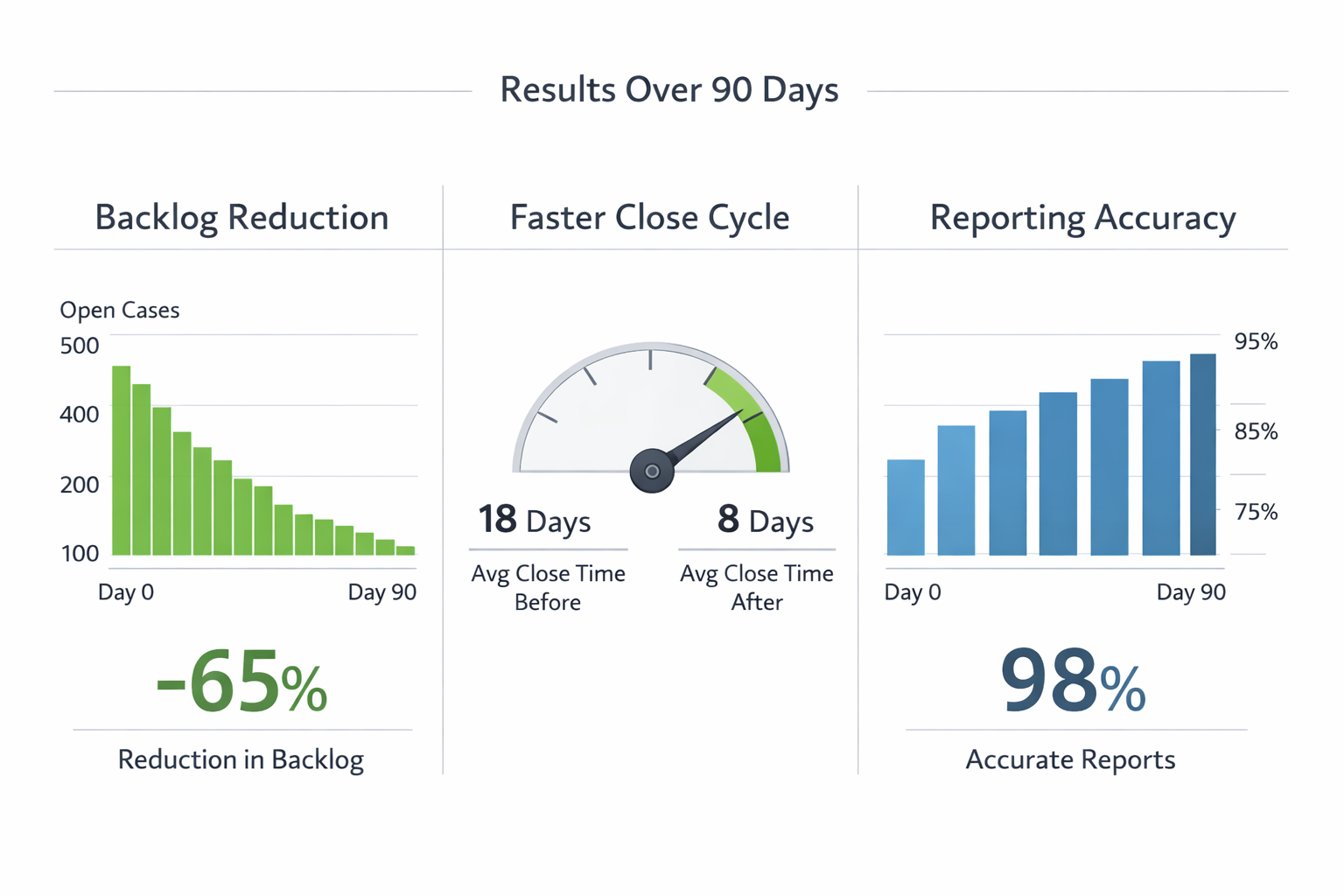
Close speed is another important measure, especially for finance-led deployments. The month-end close should become faster, not slower, over time. If entities are closing late, reconciling manually, or waiting on interface corrections, the ERP is not yet delivering value. Close speed should be paired with accuracy indicators such as reconciliation completion, journal error rates, and subledger-to-ledger alignment.
Reporting quality matters because leadership needs confidence in consolidated numbers. If entities are interpreting definitions differently, if dimensions are inconsistent, or if data latency is high, management reporting loses credibility. Stabilization should improve not just how fast reports are produced, but how much trust users place in them.
User adoption is the final metric that often gets ignored. A system can be live and still be functionally bypassed if users refuse to trust it. Adoption should be measured through actual transaction behavior, training completion, support call trends, and reduction in unauthorized workarounds. When people stop asking how to escape the system and start using it as the default operating platform, stabilization is taking hold.
A good metric set balances lagging indicators and leading indicators. That allows leaders to see whether the ERP is merely surviving or truly becoming operationally reliable.
10. A practical roadmap for the first 90 days after a troubled ERP launch
The first 90 days after a troubled launch should be treated as a structured recovery period. The goal is not to fix everything at once. The goal is to restore control, stop the bleeding, and create a path toward durable stability. A realistic roadmap helps the organization avoid panic-driven decisions and keeps attention focused on the highest-risk failure points.
Days 1–15: Stabilize visibility and containment
Start by creating a single view of issues, broken by entity, process, severity, and business impact. Establish daily command center reviews and separate the urgent from the important. Freeze nonessential change requests so the team is not destabilized by new variables. Identify the critical business processes that must be protected first: order-to-cash, procure-to-pay, record-to-report, cash management, and compliance obligations. Put workarounds under control and document them, even if they must remain temporary.
Days 16–30: Attack root causes and critical interfaces
Once the most dangerous issues are contained, focus on recurring failure patterns. Examine master data quality, integration failure points, approval bottlenecks, and configuration mismatches. Prioritize defects that affect multiple entities or block high-volume transactions. Assign clear owners and deadlines. At this stage, the program should begin distinguishing one-off incidents from systemic design flaws.
Days 31–60: Reinforce controls and improve process reliability
Introduce stronger reconciliation routines, tighter control evidence, and better exception monitoring. Review local variations and decide which ones are truly required. Reduce unnecessary manual steps, especially in finance and reporting. Reassess training gaps and role clarity. Many post-go-live failures are actually usability or handoff failures in disguise.
Days 61–90: Transition from recovery to steady-state optimization
By this point, the command center should begin handing recurring issues to steady-state support teams while retaining oversight of unresolved structural risks. Establish performance baselines for close speed, incident volume, reporting quality, and user adoption. Confirm which temporary workarounds can be retired and which need a formal redesign. Build the backlog for phase-two improvements with business prioritization, not just technical urgency.
The roadmap should be supported by a visible leadership narrative. People need to know that stabilization is a recognized program phase with executive backing, not a sign that the launch failed irreparably. That framing matters because confidence is part of operational recovery.
Conclusion
Stabilizing a multi-entity ERP program is not about applying more pressure to the same design. It is about changing the operating model around the system so the organization can absorb complexity without collapsing into manual workarounds and continuous incidents. The most successful recovery efforts treat stabilization as a disciplined phase of transformation, not as a temporary support burden.
The core lessons are consistent. First, go-live is not the end of the project. Second, multi-entity operations introduce legal, financial, and technical complexity that cannot be simplified away with generic templates. Third, modular architecture, strong integration discipline, and explicit decision rights reduce the blast radius of issues. Fourth, regulatory readiness, process harmonization, and analytics must be built into the design rather than added later. Finally, stabilization success should be measured by business continuity, close performance, reporting confidence, and adoption.
If a multi-entity ERP launch feels like it is starting to unravel, that does not mean failure is inevitable. It means the program needs a sharper stabilization model, faster escalation paths, and a more realistic architecture for the complexity it was meant to support. With the right structure in place, a troubled launch can still become a durable enterprise platform.