Modern Logging and Monitoring for Web Apps: Trends, Tools, and Best Practices in 2026
Modern web applications are no longer simple request/response systems. They are distributed, event-driven, cloud-hosted, and constantly changing. A single user action may touch a browser, API gateway, auth service, cache, queue, database, third-party API, and background worker before the transaction is complete. In that environment, traditional “check the logs when something breaks” practices are too slow, too fragmented, and too brittle.
In 2026, the most effective teams treat logging and monitoring as part of a broader observability strategy. Instead of relying on isolated logs or coarse infrastructure metrics, they build systems that can answer operational, performance, and security questions using connected telemetry: logs, metrics, traces, and events. The shift is not just about tooling. It is about designing systems so that the right signals are emitted, correlated, stored, protected, and acted on in near real time.
This blog post explores what modern logging and monitoring looks like for web applications in 2026. It covers the telemetry layers that matter, why observability is replacing siloed monitoring, how OpenTelemetry has become the de facto instrumentation standard, how SLO-driven alerting changes operations, and how AI-assisted anomaly detection is reshaping incident response. It also examines the security and compliance implications of application logs, plus how to choose between open source, SaaS, and cloud-native platforms without locking yourself into a dead-end architecture.
Introduction to Modern Logging and Monitoring for Web Apps
Modern logging and monitoring starts with a simple assumption: the application will fail in ways you did not predict, and the only way to respond quickly is to preserve enough context to understand what happened. A log line alone is often insufficient. A CPU graph alone is often misleading. A distributed trace without business context can still leave engineers guessing. That is why modern platforms collect multiple telemetry types and organize them around shared identifiers such as request IDs, trace IDs, tenant IDs, user IDs, and deployment versions.
For web apps, the practical goal is not to collect everything. It is to collect the right things with enough fidelity to support debugging, reliability engineering, security analysis, and compliance workflows. The best systems are intentionally designed around high-signal telemetry: structured logs that are machine-readable, metrics that represent system health and user impact, traces that show the request path, and events that capture meaningful state transitions like checkout completion, deployment rollouts, or auth failures. OpenTelemetry’s model reflects this multi-signal approach and supports logs, traces, and metrics in a vendor-neutral way. (opentelemetry.io)
The modern challenge is operational, not conceptual. Most teams already generate huge volumes of telemetry. The bottleneck is interpretation: alert fatigue, missing correlations, fragmented dashboards, over-collection of sensitive data, and tooling sprawl. In 2026, logging and monitoring are increasingly judged by whether they reduce mean time to detect, mean time to understand, and mean time to remediate. The winning architectures are not the ones with the most dashboards. They are the ones that make the right next action obvious.

Why Observability Is Replacing Siloed Logging and Basic Monitoring
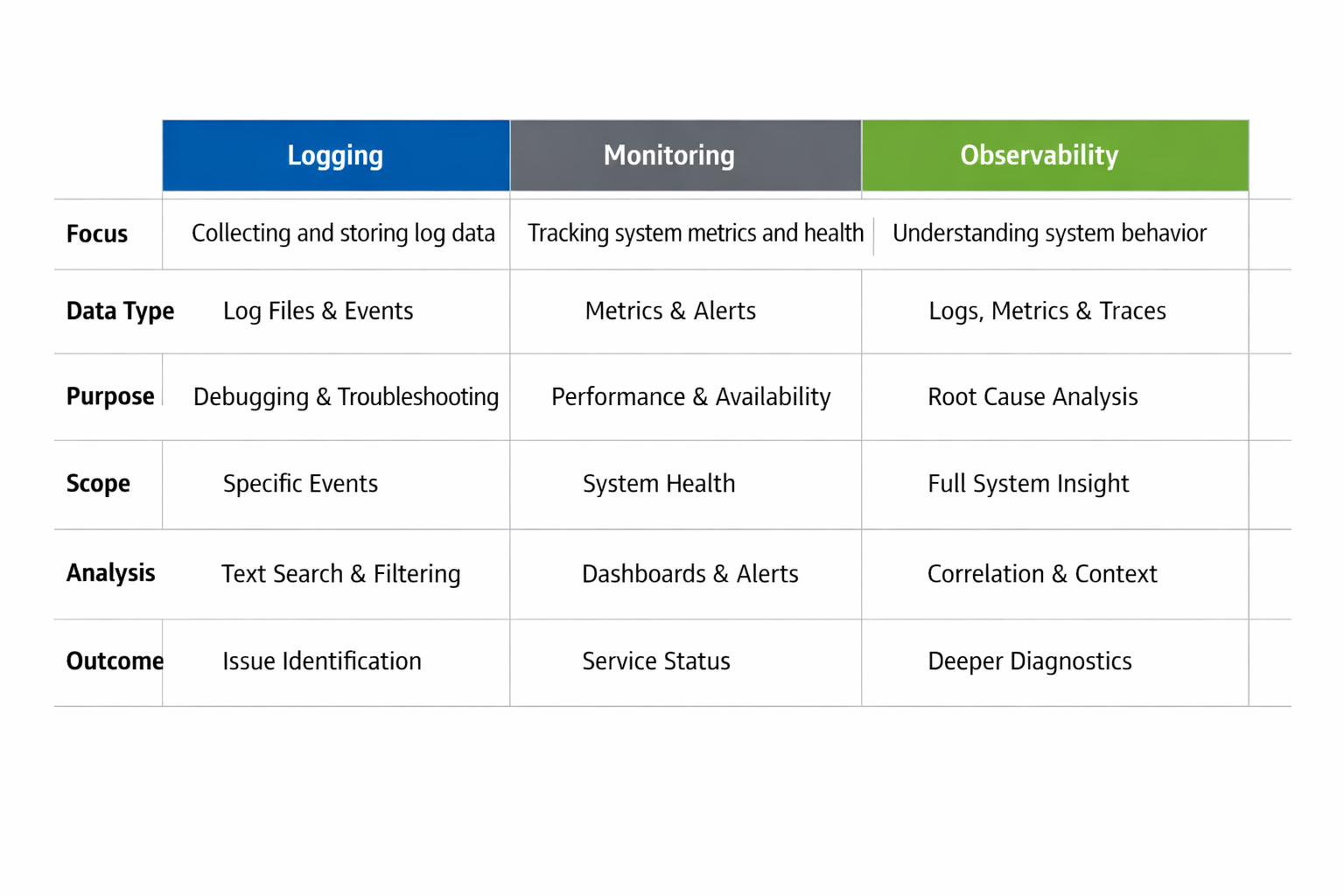
Traditional logging and monitoring evolved in separate silos. Logs were used for debugging. Metrics were used for dashboards. Traces were used by advanced teams, often only in a few services. Each system had its own tooling, retention model, query language, and operational workflow. This fragmentation created blind spots: alerts would fire without explaining root cause, logs would contain context that was never correlated to request paths, and traces would point to a slow service without indicating whether the issue affected users.
Observability replaces this fragmented model by focusing on questions rather than signals. Instead of asking, “What do the logs say?” teams ask, “Why is checkout latency elevated for mobile users in one region?” That question may require traces to identify the bottleneck, logs to inspect a failing downstream request, metrics to confirm the blast radius, and events to correlate with a deploy or feature flag change. OpenTelemetry’s definition of observability emphasizes generating, exporting, and collecting telemetry across traces, metrics, and logs, with vendor-agnostic interoperability across backends. (opentelemetry.io)
This shift matters because web apps now change too fast for static dashboards and manually curated alert lists to keep up. Continuous deployment, microservices, autoscaling, and serverless execution create a moving target. Observability reduces the friction between “something is wrong” and “here is the evidence chain.” It also supports cross-functional workflows: engineering uses it to debug, SRE uses it to manage reliability, security uses it to investigate suspicious behavior, and product teams use it to understand user experience and feature adoption.
Another reason observability is winning is that it aligns better with service-level thinking. Rather than alerting on every symptom in every layer, teams define service level indicators and objectives, then monitor whether user-visible behavior is within bounds. Google’s SRE guidance emphasizes choosing metrics that drive the right action and alerting on user impact rather than low-level noise. Prometheus alerting guidance similarly recommends keeping alerting simple, focusing on symptoms, and paging only when there is something actionable to do. (sre.google)
Core Telemetry Layers: Logs, Metrics, Traces, and Events
A mature web app observability stack is built on four complementary telemetry layers: logs, metrics, traces, and events. Each serves a different purpose, and none should be treated as a full replacement for the others.
Logs
Logs are time-stamped records of discrete occurrences. In web apps, they are essential for debugging application logic, auditing security-sensitive actions, and preserving contextual details that are too rich or too variable for metrics. The best logs are structured, consistent, and correlated to traces and requests. OpenTelemetry treats logs as a first-class signal and explicitly supports log correlation with trace context and resource context. (opentelemetry.io)
Metrics
Metrics are numeric measurements captured over time. They are best for trends, alerting, and dashboards. Common examples include request rate, error rate, latency percentiles, queue depth, cache hit ratio, and saturation indicators. OpenTelemetry describes metrics as stable signals and notes that application and request metrics are important indicators of availability and performance. (opentelemetry.io)
Traces
Traces represent the path of a request as it flows across services and components. They are indispensable for distributed systems because they reveal timing, dependency chains, retries, and fan-out behavior. If a request takes two seconds longer than expected, traces show where that time was spent. In a web app, traces are often the fastest way to locate the service or dependency responsible for a slowdown. OpenTelemetry’s tracing model is designed around request context propagation and span relationships. (opentelemetry.io)
Events
Events are meaningful state transitions or occurrences: a user signed in, a payment succeeded, a deployment started, a feature flag flipped, or a fraud check failed. In practice, events often look like high-value logs with a stronger domain meaning. They are useful for business analytics, incident correlation, and workflow automation. OpenTelemetry describes events as a specific type of log in its signal model, which reinforces the idea that they should be context-rich and machine-processable. (opentelemetry.io)
The key operational principle is that these signals should reinforce one another. Metrics tell you that a problem exists. Traces help you localize it. Logs explain the specific failure. Events connect it to business and operational changes. A useful visualization of the telemetry stack looks like this:

Structured Logging, Correlation IDs, and Context-Rich Events
Plain-text logging still exists, but it is increasingly inadequate for modern applications. In 2026, structured logging is the default choice for serious web apps because it makes telemetry queryable, filterable, and automatable. A structured log is not just a message string; it is a record with fields such as timestamp, severity, service name, environment, request ID, trace ID, span ID, tenant, route, status code, latency, and error class.
Correlation IDs are the connective tissue of this model. A request ID or trace ID lets you follow a single user action across multiple services and storage layers. OpenTelemetry explicitly recommends including TraceId and SpanId in log records so logs can be directly correlated with traces that share the same execution context. That makes cross-service debugging dramatically faster, especially in systems with load balancers, queues, workers, and asynchronous workflows. (opentelemetry.io)
Context-rich events go further by preserving business meaning. Instead of logging “checkout failed,” a context-rich event might include the customer segment, payment provider, error category, cart value, region, and deployment version. This makes the event useful not only to engineers but also to incident responders, support teams, and analysts. The key is to avoid overloading the event with unbounded free text. Fields should be explicit, schema-driven, and stable across releases.
There are two practical rules that matter here. First, log for machines first and humans second. Humans can still read JSON when needed, but alert routing, dashboarding, and correlation depend on predictable fields. Second, keep the log schema as close as possible to the domain model. If your application has concepts like tenant, subscription, plan, account state, feature flag variant, or checkout step, those belong in the log schema.
OpenTelemetry and Vendor-Neutral Instrumentation as the Emerging Standard
OpenTelemetry has become the most important instrumentation standard in the observability ecosystem because it solves a long-standing portability problem. Before OpenTelemetry, teams often instrumented applications directly against a vendor’s SDK or used proprietary agents that made migrations difficult. OpenTelemetry provides a vendor-neutral framework for generating, collecting, and exporting telemetry, and it is explicitly designed to work with both open source and commercial backends. (opentelemetry.io)
That vendor neutrality matters for three reasons. First, it reduces lock-in. Teams can switch backends without rewriting application instrumentation. Second, it improves consistency across environments, because the same APIs and semantic conventions can be used in local development, Kubernetes clusters, serverless functions, and edge runtimes. Third, it creates an ecosystem where instrumentation can be standardized across organizations, making it easier to onboard new services and teams.
OpenTelemetry also supports both code-based and zero-code instrumentation. Code-based instrumentation gives deeper insight and lets teams emit business-specific telemetry. Zero-code instrumentation is ideal for fast adoption, legacy services, or environments where source code changes are costly. OpenTelemetry’s documentation explicitly frames these as complementary approaches rather than competing ones. (opentelemetry.io)
The emerging pattern in 2026 is “instrument once, export anywhere.” Applications emit telemetry to the OpenTelemetry Collector, which can enrich, filter, redact, transform, and export signals to one or more destinations. This architecture is powerful because it separates instrumentation from backend choice and centralizes policy enforcement for security and cost control. OpenTelemetry’s log specification and overall architecture both emphasize collection through the Collector and correlation across signals. (opentelemetry.io)
For teams building new systems, this is now the most future-proof default. For teams maintaining old systems, it is the safest migration path because it can be introduced incrementally, service by service.
Real-Time Monitoring, Alerting, and SLO-Driven Operations
Monitoring is only useful if it drives timely action. In modern web apps, that means real-time or near-real-time monitoring tied to explicit operational objectives. The most effective teams do not alert on every anomaly. They alert on symptoms that matter to users and business outcomes. Prometheus guidance is clear on this point: keep alerting simple, alert on symptoms, have good consoles, and avoid pages where there is nothing to do. (prometheus.io)
Service level objectives are central to this model. An SLO defines an acceptable reliability or performance target, usually expressed as a percentage over a time window, such as 99.9% successful requests or a latency target for a critical route. SLIs are the measurements that determine whether the SLO is being met. This framework gives operations a concrete way to prioritize. If the SLO is healthy, you do not page just because a dashboard looks odd. If the SLO is in danger, you page because user impact is imminent or already happening. Google’s SRE guidance emphasizes selecting metrics that drive the right action and using them to determine whether a service is healthy. (sre.google)
Alerting stacks have also become more sophisticated. Prometheus Alertmanager groups, deduplicates, routes, inhibits, and silences alerts, preventing notification storms during outages. That matters in distributed systems where a single root cause can trigger hundreds of downstream symptoms. The best alerting pipelines are symptom-based, grouped by service or incident, and tightly integrated with runbooks and dashboards. (prometheus.io)
A healthy alerting strategy usually includes:
user-visible error rate alerts
latency alerts at the highest practical layer
saturation alerts for critical resource exhaustion
freshness or liveness alerts for batch and asynchronous workflows
deployment-change correlation to identify release-induced incidents
The operational goal is not to detect everything. It is to detect the few things that indicate a meaningful user impact, then present enough context to resolve them quickly.
Security, Privacy, and Compliance in Application Logs
Security and observability are tightly coupled, but logs are also a liability if handled poorly. Application logs can contain authentication data, session identifiers, IP addresses, personal information, business-sensitive events, and operational details that should not be exposed broadly. OWASP’s Logging Cheat Sheet stresses that application logging is much more than server logs and warns developers to sanitize data to prevent log injection, remove or mask secrets, and protect logs from tampering, unauthorized access, modification, and deletion. (cheatsheetseries.owasp.org)
In 2026, secure logging is built on three principles: minimization, redaction, and protection. Minimization means collecting only what you need. Redaction means removing or hashing secrets and sensitive identifiers before they are stored or exported. Protection means securing logs in transit and at rest, restricting access, and monitoring for tampering or loss. OpenTelemetry’s security guidance reinforces that telemetry collection can inadvertently capture sensitive or personal information and that implementers are responsible for compliance with applicable privacy laws and regulations. (opentelemetry.io)
For regulated applications, the compliance implications are significant. Logs can fall under privacy laws, retention mandates, incident response requirements, and internal policy controls. This is especially true for applications that handle financial data, healthcare data, identity data, or enterprise customer records. A practical logging policy should define:
which fields are forbidden
which fields must be hashed or tokenized
retention durations by log class
access control by role or purpose
redaction requirements for application teams and collectors
approval workflows for emergency log access
A useful mental model is to treat logs as semi-public operational records, not as a safe place to dump raw request payloads. If you would be uncomfortable showing a log line to a support vendor or an auditor, it probably contains too much data. Strong observability programs increasingly embed redaction rules in collectors and pipelines so that sensitive material is removed before it reaches a backend.
AI-Assisted Observability and Anomaly Detection Trends
AI has become a practical part of observability, but not in the simplistic “AI replaces monitoring” sense. The most useful applications of AI in 2026 are triage, summarization, anomaly detection, and incident correlation. Large telemetry datasets are hard for humans to scan manually. AI can help surface patterns such as unusual error clusters, emerging latency regressions, or changes in request distribution after a deployment. It can also summarize a noisy incident timeline into a coherent sequence of events.
The biggest value proposition is reducing cognitive overload. During an incident, engineers are flooded with graphs, logs, traces, alerts, deploy events, and chat messages. AI-assisted tools can cluster related symptoms, highlight likely causal paths, and propose next queries. This does not eliminate the need for engineering judgment, but it shortens the time to useful context.
That said, AI observability has real constraints. Models can hallucinate, overfit to noisy telemetry, or obscure the underlying evidence. That means AI output should be treated as a hypothesis generator, not an oracle. The best systems keep the raw telemetry accessible and provide transparent links from AI-generated summaries back to original logs, traces, and metrics.
A practical trend in 2026 is the use of machine learning for baseline-aware anomaly detection, especially in systems with strong seasonality or high traffic variability. Static thresholds are often too blunt for user-facing apps. A 2% error rate may be catastrophic in one service and normal in another, depending on traffic volume, user segment, and downstream dependency behavior. AI-assisted systems are increasingly being used to identify deviations from normal behavior across multiple dimensions at once.
For engineering teams, the key is to use AI where it reduces toil: noisy alert deduplication, incident summarization, root-cause hinting, and anomaly clustering. Use humans for decisions, escalation, and remediation.
Choosing the Right Platform: Open Source vs SaaS vs Cloud-Native Tools
Choosing an observability platform is no longer just a tooling decision. It is an architectural and organizational decision. The right answer depends on scale, regulatory requirements, staffing, cloud strategy, and the degree of vendor flexibility you need.
Open Source
Open source stacks are attractive when control, portability, and cost transparency matter most. Common benefits include self-hosting, deep customization, and avoidance of proprietary data models. They also pair naturally with OpenTelemetry because the instrumentation layer is vendor-neutral. The tradeoff is operational burden: you own upgrades, storage scaling, query performance, multi-tenancy, and reliability of the observability stack itself.
SaaS
SaaS observability platforms are appealing for teams that want speed and low operational overhead. They often provide polished alerting, dashboards, AI-assisted analysis, and integrations out of the box. The downside is potential lock-in around pricing, retention, query semantics, and proprietary enrichment features. A strong OpenTelemetry-based ingestion layer can reduce that risk by keeping the application instrumentation portable.
Cloud-Native Tools
Cloud-native observability tools fit naturally with managed compute and storage services. They can simplify deployment and integrate tightly with IAM, logging pipelines, and service meshes. However, cloud-native convenience can sometimes come at the cost of cross-cloud portability or advanced query flexibility. These tools are often best for teams already standardized on a specific cloud provider and willing to trade some openness for simplicity.
The most future-proof strategy in 2026 is usually:
instrument applications with OpenTelemetry
centralize processing in an OpenTelemetry Collector or equivalent pipeline
choose backends based on operational needs, not instrumentation constraints
preserve the option to send the same data to multiple destinations
This is especially important for organizations that expect to change vendors, run hybrid environments, or consolidate observability across business units over time.
Implementation Roadmap, Common Pitfalls, and Future Trends
A successful observability rollout should be incremental, not disruptive. The goal is to improve visibility without creating a logging firehose or a maze of half-finished dashboards. A practical implementation roadmap looks like this:
Define reliability goals first. Identify the services that matter most and write down the SLIs and SLOs that reflect user experience.
Standardize structured logging. Create a schema with required fields such as service, environment, request ID, trace ID, route, status, latency, and error class.
Adopt OpenTelemetry at the application layer. Start with the highest-value services and instrument traces and metrics before expanding log correlation.
Build correlation into the pipeline. Ensure logs, metrics, and traces share common identifiers and are enriched with deployment and resource metadata.
Establish alerting rules from SLOs. Prefer symptom-based alerts and route them through an alert manager with deduplication and grouping.
Add redaction and retention controls. Enforce data minimization at the collector or pipeline layer.
Layer in AI-assisted analysis carefully. Use it to summarize and detect anomalies, not to replace evidence-based debugging.
Common pitfalls still trip up mature teams:
logging too much, especially raw payloads
logging too little context to be actionable
using unstructured text that is hard to query
alerting on every error instead of user impact
storing sensitive data in plain logs
creating dashboards without operational ownership
instrumenting services without a correlation strategy
failing to align retention and access policies with compliance requirements
Looking ahead, the most important trends are clear. OpenTelemetry will continue to be the default instrumentation path for new systems. The Collector pattern will expand as a central enforcement point for enrichment, filtering, and redaction. AI will increasingly assist with triage, not replace it. And observability platforms will be judged more by interoperability, policy control, and signal quality than by how many charts they can display.
The future of logging and monitoring is not more noise. It is better context, tighter correlation, faster diagnosis, and stronger operational discipline.
Conclusion
Modern logging and monitoring for web apps has matured into full observability. The core idea is simple: logs, metrics, traces, and events are most valuable when they are structured, correlated, secure, and aligned to service objectives. In 2026, the strongest teams use OpenTelemetry to keep instrumentation portable, rely on SLO-driven alerting to reduce noise, and apply strict privacy controls to keep telemetry safe and compliant.
The practical takeaway is that observability is no longer a separate layer you add after the fact. It is part of system design. If you build correlation into your application, standardize telemetry schemas, protect sensitive data, and route alerts around user impact, you will spend less time guessing and more time fixing the right thing.