
How to Hire the Right Development Consultant: From Strategy to Maintenance
Hiring a development consultant is no longer just about finding someone who can write code. In 2026, the best consultants help you validate the market, shape the product strategy, define the architecture, accelerate delivery, support launch, and keep the product healthy after release. In other words, the right consultant helps you reduce risk across the full lifecycle of building digital products.
That shift matters because the bar for product teams has risen. Users expect polished experiences. Investors expect evidence of traction. Internal stakeholders expect faster delivery and clearer ROI. At the same time, AI has changed what good consulting looks like. A consultant who simply “knows a stack” is no longer enough. Modern teams need partners who can use AI to improve research, planning, prototyping, testing, documentation, and operational efficiency without sacrificing product judgment or engineering discipline.
The result is a market where consulting quality is more visible than ever. Good consultants shorten the path from idea to outcome. Weak consultants create expensive detours: unclear scopes, bloated builds, shallow strategy, and hard-to-maintain systems. That is why hiring decisions need to be structured around the full product journey, not just the development phase.
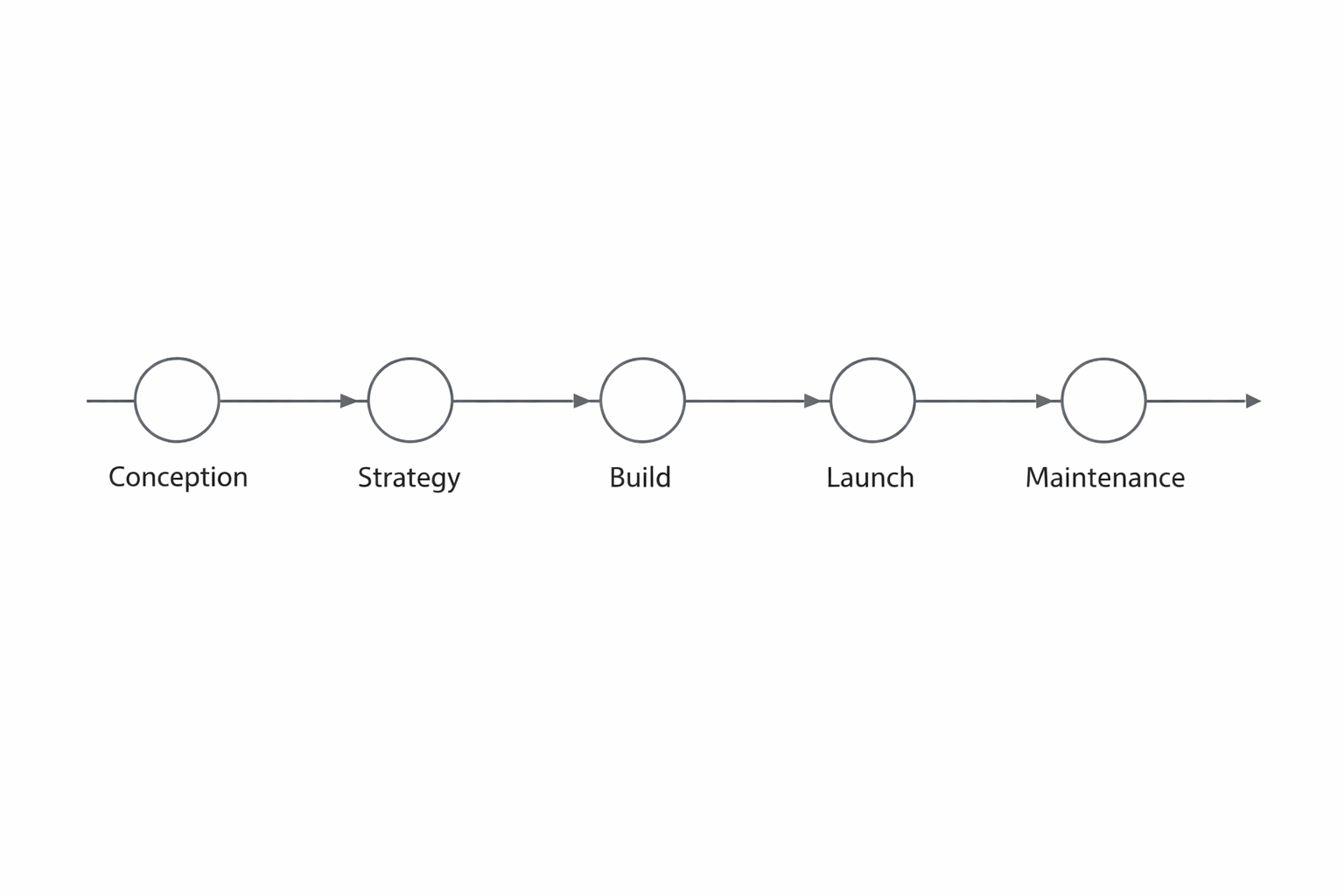
This guide walks through each phase of the product lifecycle and explains what to expect from a strong development consultant, how to evaluate candidates, and which mistakes to avoid. Whether you are a founder validating a new app, a product leader modernizing an internal platform, or an executive trying to get more from your build budget, the goal is the same: hire for outcomes, not just output.
Phase 1 — Conception and discovery: validating the idea, business case, and target users
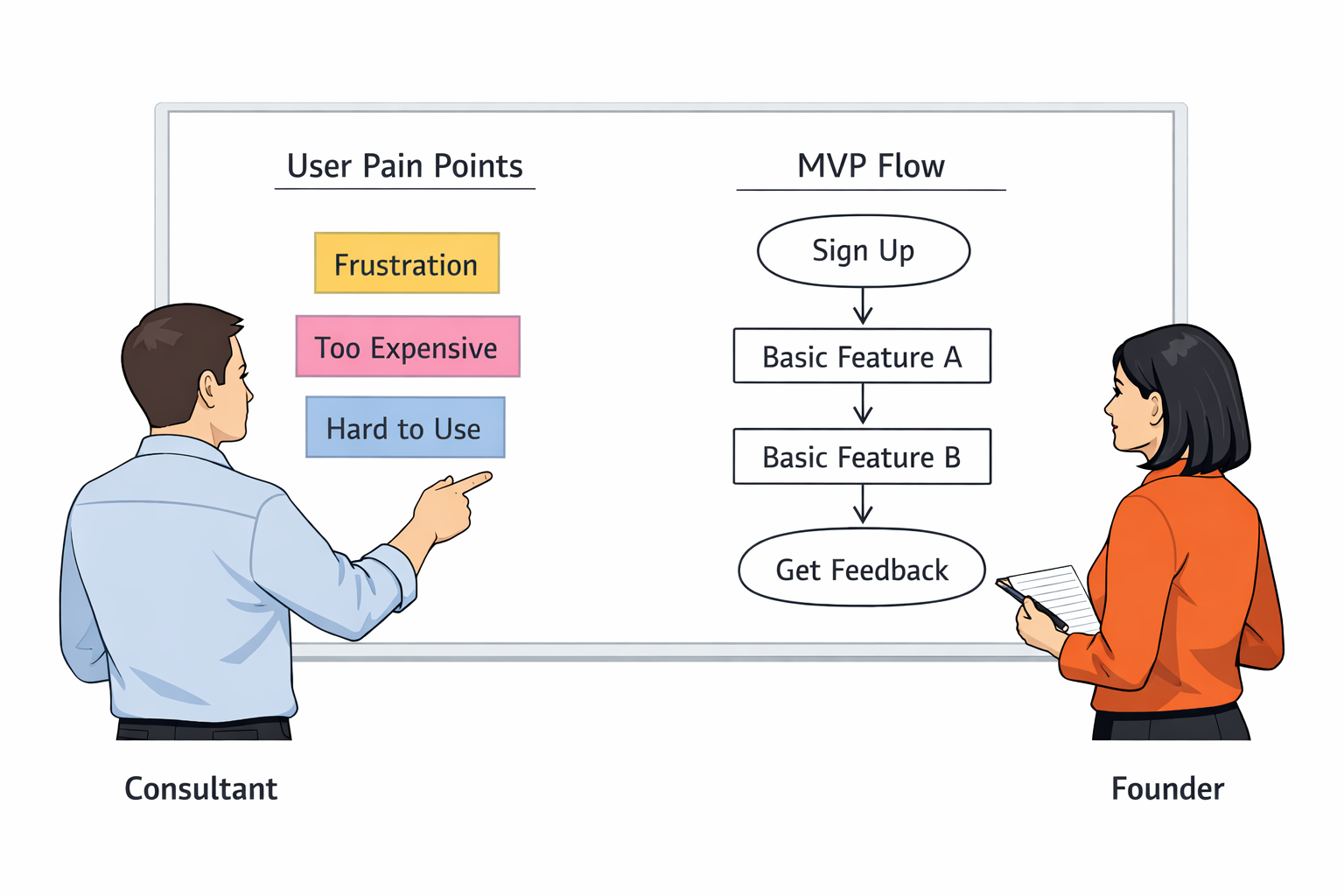
The earliest stage is often the most underrated. Many teams assume they need a development consultant only after they have a clear idea and some funding. In reality, the best consultants help you determine whether the idea should be built at all, what problem it truly solves, and who the real users are. This discovery phase is where expensive mistakes are prevented.
A strong consultant should start with questions, not solutions. What pain point are you solving? How urgent is it? Who experiences it most acutely? What alternatives already exist? What would make a user switch? What business model supports the product? These questions sound simple, but they force clarity around the commercial case before design and engineering begin. If a consultant skips them and jumps straight to wireframes or architecture, they may be optimizing for activity rather than value.
Discovery work should also include lightweight validation. That may mean user interviews, competitive analysis, landing page testing, internal stakeholder workshops, or rapid prototyping. The point is to reduce uncertainty before committing to full-scale development. A consultant with the right mindset will help translate vague ideas into testable assumptions. For example, instead of “build a marketplace for skilled freelancers,” a better discovery outcome might be “validate whether enterprise customers will pay for pre-vetted specialists in a specific category with same-week onboarding.” That level of precision shapes everything that follows.
This phase is also where AI can raise the standard. Consultants can use AI-assisted research to summarize market patterns, map competitor positioning, accelerate interview synthesis, and generate early concept variants. But AI should not replace judgment. The best consultants use AI to speed up analysis, while still grounding decisions in real user data and business goals. If the consultant cannot articulate why the product matters, who it is for, and what success looks like, they are not ready for the build.
Phase 2 — Strategy and roadmap: defining scope, priorities, tech approach, and success metrics
Once the concept is validated, the next job is to define a strategy that is realistic, sequenced, and measurable. This is where many projects fail silently. Teams either overbuild, under-scope, or try to satisfy too many goals at once. A good development consultant helps turn ambition into a roadmap.
At this stage, scope matters as much as vision. The consultant should help you define the minimum viable product, not as the smallest possible product, but as the smallest product that can prove value. That means identifying must-have features, nice-to-have features, and later-phase capabilities. The roadmap should show how each release reduces risk or increases learning. If a feature does not advance a business goal, it belongs on a later milestone or out of scope entirely.
A strong strategy should also address the technical approach. Should you build custom software, configure an existing platform, or combine both? Should the system be modular from day one, or can it start simpler? What integrations are required? What data model will support future growth? These questions are not just engineering choices; they affect budget, speed, maintainability, and flexibility. A consultant who understands product and technology will align these decisions with your commercial priorities.
Success metrics are equally important. Too many projects launch without clear measures. A consultant should help define outcome-based indicators such as activation rate, conversion rate, time to task completion, support ticket volume, churn, or operational cost reduction. For internal tools, metrics might include adoption, error reduction, throughput, or cycle-time improvement. Clear metrics force the team to manage toward results instead of shipping features for their own sake.
This phase is also where AI is changing planning norms. Teams can now generate roadmap drafts, estimate effort with more context, and simulate user flows more quickly. But speed is only useful if the consultant can pressure-test assumptions and prioritize with discipline. The best consultants do not just produce a roadmap; they defend it. They explain tradeoffs, sequence the work sensibly, and keep the plan tied to the original business case.
Phase 3 — Product design and architecture: UX, system design, stack selection, and build planning
Product design and architecture are where strategy becomes tangible. In this phase, the consultant should help you determine how the product will work for users and how it will function under the hood. Good consultants treat UX and system architecture as connected disciplines, not separate silos.
On the user side, the consultant should push for clarity, simplicity, and task completion. That may include information architecture, journey mapping, wireframes, prototype testing, and UI direction. The goal is to reduce friction before development starts. A polished-looking interface is not enough. The key question is whether the user can reach value quickly and confidently. For B2B tools, that might mean fewer clicks and clearer workflows. For consumer products, it could mean better onboarding, stronger habit formation, and lower abandonment.
On the technical side, system design should be shaped by the product’s scale, complexity, and future roadmap. The consultant should help determine whether the architecture should be monolithic, modular, service-based, or API-first. They should also consider data storage, authentication, roles and permissions, third-party dependencies, observability, and deployment strategy. These choices affect resilience and long-term cost. A consultant who designs only for the first release may create expensive migration work later.
Stack selection deserves careful attention. The “best” stack is usually the one that fits your constraints: team capability, time to market, security needs, scalability, and maintenance expectations. The right consultant will not oversell fashionable tools. Instead, they will explain why a particular stack makes sense for your product lifecycle and internal resources. This is especially important when AI tools are involved. AI-assisted coding can speed up implementation, but it does not eliminate the need for strong architecture, clean interfaces, and maintainable patterns.
Build planning is the final piece of this phase. A consultant should translate design and architecture into a delivery plan that the team can execute with confidence. That means defining milestones, dependencies, estimates, risks, and quality gates. If design is vague, architecture is premature, or planning is disconnected from the roadmap, the project becomes harder to manage and more likely to slip.
Phase 4 — Development and implementation: delivery quality, engineering process, testing, and AI-enabled workflows
This is the phase most people picture when they hear “development consulting,” but it should not be treated as the whole story. By the time code is being written, the most expensive decisions have already been made. The consultant’s role now is to ensure that execution remains disciplined, transparent, and aligned with the plan.
Delivery quality starts with engineering process. A strong consultant should establish how work will move from backlog to production: sprint cadence, code review standards, branching strategy, issue tracking, documentation practices, release approvals, and stakeholder communication. These practices are not bureaucracy; they are the mechanisms that keep teams moving efficiently without losing control. If the process is too loose, quality suffers. If it is too rigid, momentum dies. The right consultant balances speed with reliability.
Testing is another critical area. A consultant should advocate for testing strategies that fit the product’s risk profile: unit tests, integration tests, end-to-end tests, usability testing, regression checks, and smoke tests. For products handling sensitive data or critical workflows, quality assurance is not optional. Testing should be planned from the start, not patched in at the end. Strong consultants also think about testability during design, which saves time later and reduces defects.
AI-enabled workflows can significantly improve development, but only if they are used thoughtfully. Consultants can use AI to assist with code generation, test case drafting, documentation, backlog refinement, and issue triage. They can also use AI to speed up repetitive tasks such as log analysis or support categorization. However, AI-generated output should always be reviewed, validated, and integrated into a disciplined workflow. The value of AI is leverage, not replacement. A consultant who treats AI as a shortcut instead of a force multiplier may introduce hidden technical debt.
This phase also exposes the consultant’s communication quality. Are they proactive about risks? Do they surface blockers early? Do they translate technical issues into business implications? Can they keep both engineering and non-technical stakeholders aligned? The best consultants make progress visible, reduce uncertainty, and keep decisions moving. They do not disappear behind tickets and standups; they create trust through clarity.
Phase 5 — Launch, promotion, and go-to-market support: release planning, messaging, growth experiments, and adoption
A product is not successful because it was built. It is successful because people use it, value it, and keep coming back. That is why the consultant’s job should not end at code completion. A strong development consultant supports launch planning and helps the team think through adoption and early growth.
Release planning should account for more than deployment. It should include feature flags, rollback plans, user communication, support readiness, and performance monitoring. A smooth launch reduces the risk of avoidable failures and gives the team a controlled way to learn from real usage. Consultants who understand launch dynamics help you avoid “big bang” releases when a phased rollout would be safer and more informative.
Messaging matters too. A consultant may not own marketing, but they should help shape product positioning by clarifying what the product does, who it is for, and why it is different. If the value proposition is weak, adoption will be harder no matter how well the product is engineered. The best consultants align product language with the actual user experience, so that onboarding, website copy, in-app guidance, and sales conversations all reinforce the same story.
Growth experiments are another valuable area of support. After launch, you often need to test onboarding flows, call-to-action placement, pricing behavior, referral prompts, trial offers, or activation nudges. A consultant with product sense will help prioritize experiments based on the biggest bottlenecks in the funnel. They will also avoid the common trap of chasing vanity metrics. The goal is to improve meaningful adoption and retention, not just traffic or sign-ups.
For B2B products, adoption support may involve customer onboarding, workflow training, integration help, and stakeholder enablement. For consumer products, it may involve habit loops, engagement triggers, and first-session optimization. In both cases, launch is the beginning of product learning, not the end. A consultant who stays engaged after release helps the team build with evidence instead of assumptions.
Phase 6 — Maintenance and optimization: monitoring, support, iteration, security, and technical debt management
Maintenance is where many consulting engagements become truly valuable, because this is where product quality either compounds or deteriorates. Once the launch excitement fades, the reality of operating software begins: bugs emerge, usage patterns change, integrations break, and new requirements appear. A good consultant helps you stay ahead of those pressures.
Monitoring should be established before or at launch. That includes application performance, uptime, error rates, user behavior, infrastructure health, and alerting thresholds. Without visibility, teams operate blind. The consultant should ensure the product has the right telemetry and that the team knows what to watch. A reliable monitoring setup allows you to detect issues early, triage faster, and protect user trust.
Support is equally important. A consultant should help define how tickets are handled, how incidents are escalated, and how fixes are prioritized. Support data often reveals what users struggle with most, making it one of the richest sources of product insight. A consultant who pays attention to support patterns can identify opportunities for UX improvements, documentation updates, and automation.
Iteration is where the product becomes more competitive over time. Based on analytics, user feedback, and business performance, the roadmap should evolve. The consultant should help distinguish between feature requests, core product improvements, and structural fixes. Not every request deserves immediate implementation, but persistent issues should inform design and technical decisions.
Security and technical debt management cannot be treated as optional. A consultant should consider patching, access control, dependency management, data protection, auditability, and vulnerability response. Technical debt also needs explicit attention. If shortcuts were necessary to launch quickly, they should be cataloged and scheduled for remediation. Left unmanaged, technical debt slows future development and increases failure risk.
In practice, the best consultants help teams build operational maturity. They make maintenance visible, measurable, and fundable. That is a major differentiator, because many vendors optimize for launch while ignoring the long-term cost of ownership. Mature consulting means thinking beyond delivery to durability.
What to look for when hiring a consultant: expertise, communication, transparency, proof of outcomes, and cultural fit
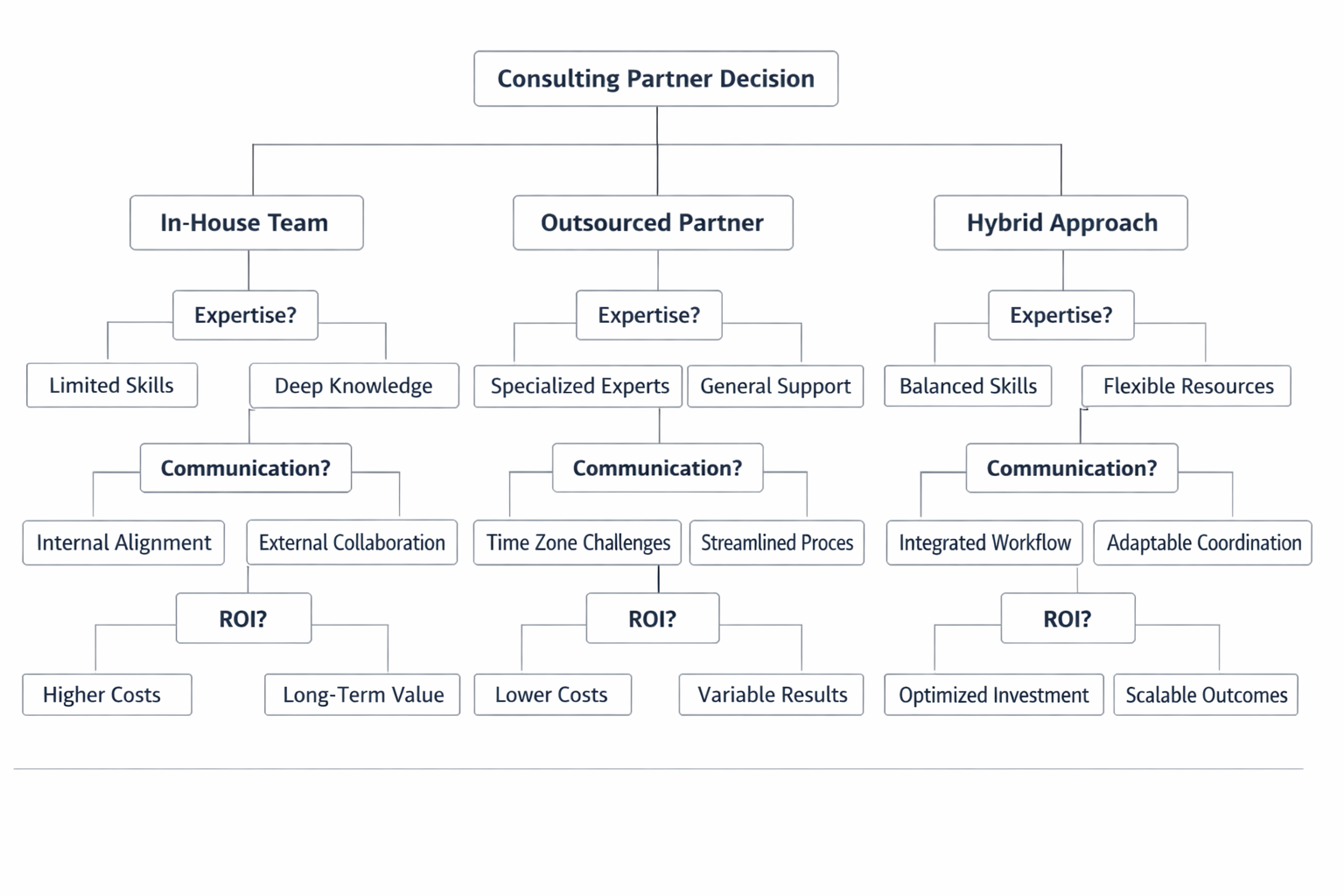
Hiring the right development consultant requires looking beyond resumes and portfolios. The best candidate is not necessarily the one with the longest client list or the flashiest demos. You want someone who can combine technical expertise, product judgment, and dependable execution.
First, evaluate expertise in context. Does the consultant understand the type of product you are building? Have they worked on similar complexity, whether that means regulated systems, SaaS platforms, marketplaces, internal tools, mobile apps, or AI-enabled products? Domain familiarity matters because it shortens the learning curve and improves judgment. A consultant should be able to explain not just what to build, but why it matters for your specific business.
Communication is just as important. Strong consultants explain tradeoffs clearly, ask good questions, and make uncertainty visible. They should be able to speak to founders, designers, engineers, and business stakeholders without confusion. If a consultant cannot translate technical issues into business language, you will spend too much time bridging gaps.
Transparency is non-negotiable. You want clear estimates, realistic assumptions, visible risks, and honest status updates. Good consultants do not hide uncertainty; they manage it. They also explain how they work: discovery process, delivery cadence, QA approach, reporting structure, and collaboration model. That transparency is often the best indicator of professionalism.
Proof of outcomes matters more than proof of activity. Ask for case studies, before-and-after examples, launch metrics, performance improvements, or measurable operational gains. Look for evidence that the consultant contributed to outcomes, not just tasks. If possible, speak with previous clients and ask what happened after the first milestone. Did the product improve? Did the team gain capability? Was the work sustainable?
Cultural fit should not be ignored. You are not just hiring talent; you are choosing a partner who will influence decisions and shape momentum. Do they respect your team? Do they adapt to how your organization works? Are they collaborative without being passive? The best consulting relationships feel like a force multiplier, not an external dependency.
Red flags and common hiring mistakes: vague estimates, no discovery process, weak documentation, and tool hype without substance
There are a few patterns that repeatedly signal trouble. The first is vague estimating. If a consultant gives you a confident number too early without understanding your problem, that estimate may be more theater than expertise. Good consultants are comfortable saying, “We need discovery before we can size this accurately.” That honesty is a strength, not a weakness.
The second red flag is skipping discovery. If a consultant is eager to start development before validating the business case, user needs, scope, or success metrics, they may be optimizing for billable work rather than project success. Discovery may feel slower at the start, but it prevents much larger delays later. A consultant who avoids it may be trying to hide uncertainty rather than reduce it.
Weak documentation is another common mistake. If the consultant cannot produce clear decisions, system diagrams, handoff notes, and implementation details, your team will struggle after they leave. Documentation is not an administrative extra; it is part of the deliverable. Without it, maintenance becomes harder, onboarding slows down, and dependency on the consultant increases unnecessarily.
Tool hype without substance is especially common in the AI era. Many consultants now advertise AI expertise, but the real question is whether they can apply AI in ways that improve product outcomes. If the pitch is full of buzzwords and light on concrete use cases, beware. Ask how AI will affect planning, delivery, testing, support, or user experience. The answer should be practical, not performative.
Other mistakes include hiring based on price alone, choosing a consultant who cannot explain tradeoffs, failing to check references, and expecting one person to solve product, design, engineering, and growth without focus. The right hire may not be the cheapest, but they are usually the one who reduces total cost by preventing rework, delay, and technical debt.
Why Rootcode: small-town roots, global ambitions, and an AI-first consulting mindset built for modern product teams
Rootcode represents the kind of consulting partner many modern teams are looking for: grounded in practical execution, ambitious in scope, and shaped by the realities of building products in a fast-moving market. The phrase “small-town roots, global ambitions” reflects a useful truth about great consulting teams. Strong product partners do not need to come from flashy environments to deliver sophisticated work. What matters is the discipline to think clearly, build responsibly, and stay focused on outcomes.
An AI-first consulting mindset is especially important now. It does not mean using AI everywhere for the sake of novelty. It means integrating AI into the consulting workflow in ways that improve research, planning, prototyping, delivery, and optimization while maintaining human accountability for judgment and quality. The best AI-first teams understand that speed is only valuable when it is paired with structure, validation, and maintainability.
For product teams, that combination is powerful. It can mean faster discovery cycles, smarter prioritization, cleaner delivery processes, better testing coverage, and more responsive iteration after launch. It can also mean a consulting relationship that feels strategic rather than transactional. Instead of simply shipping tasks, the right team helps you make better decisions at every stage of the product lifecycle.
Rootcode’s appeal lies in that broader mindset: build with ambition, but do it with discipline. For founders and business leaders, that is exactly what a modern development consultant should provide. You are not just buying implementation capacity. You are choosing a partner to help shape the product from first idea to long-term maintenance. That is a much higher bar, and the best consulting teams are built to meet it.
Conclusion: hire for the full lifecycle, not just the build
The right development consultant does far more than implement requirements. They help you validate the opportunity, define the strategy, design the product, execute the build, support launch, and maintain momentum after release. That full-lifecycle perspective is what separates a contractor from a true strategic partner.
If you remember only a few things, remember these: start with discovery, insist on clarity, evaluate proof of outcomes, and treat AI as a capability enhancer rather than a substitute for product thinking. Avoid vague estimates, skip the hype, and prioritize consultants who can communicate tradeoffs honestly. The strongest partners reduce risk, improve decision-making, and create systems that can evolve over time.
In a market where speed is expected and quality is scrutinized, hiring the right consultant is one of the highest-leverage decisions a founder or product leader can make. Choose carefully, and you do not just get a project delivered. You get a better product organization.