
How to Choose the Right Tech Stack for a New Product in 2026
Choosing a tech stack for a new product is one of the highest-leverage decisions a technical team can make. The wrong choice can slow delivery, inflate cloud spend, create hiring friction, and lock the product into architectural patterns that are painful to unwind. The right choice, by contrast, can accelerate development, reduce operational burden, and give the team room to evolve as the product-market fit story becomes clearer.
In 2026, stack selection is more nuanced than simply picking the “most modern” tools. A good stack is not the one with the most hype; it is the one that best fits the product’s goals, the team’s skill set, the delivery timeline, and the expected scale of the business. That means thinking in systems, not trends. It means distinguishing what is essential for the first release from what can be deferred until the product proves demand. It also means accepting that every technology choice carries tradeoffs in cost, complexity, and future flexibility.
For founders, product leaders, and engineering teams, stack selection should be treated as a strategic exercise. The objective is not perfection. The objective is to make a set of deliberate choices that maximize speed now without creating unacceptable constraints later. This post walks through a practical framework for making those decisions in 2026, from defining the product to weighing infrastructure, AI integration, hiring, cost, and long-term maintenance.
1. Why Tech Stack Choice Matters for Speed, Cost, Hiring, and Flexibility
Tech stack choice directly shapes how quickly a team can build, test, and ship. A stack with strong conventions, excellent tooling, and a large ecosystem reduces friction in day-to-day work. Developers spend less time solving plumbing problems and more time implementing product value. That matters most in the early stages, when the team needs rapid iteration and tight feedback loops. A stack that is technically elegant but slow to operate can be a competitive disadvantage if it delays customer learning.
Cost is just as important, but it is easy to misunderstand. The obvious cost is licensing and cloud infrastructure, yet the largest long-term costs are usually labor and operational complexity. A “cheap” stack that requires scarce expertise or constant maintenance can end up being far more expensive than a managed, opinionated platform. Similarly, a very flexible stack can create hidden overhead if every new feature requires custom engineering instead of using built-in primitives.
Hiring is often underestimated. Your stack determines the size and quality of the candidate pool. If you choose a technology that only a small number of engineers know well, recruiting becomes harder and more expensive. If you choose a stack that is widely used and easy to learn, you gain resilience in the labor market. This is especially important for startups and new products that need to scale a team quickly.
Long-term flexibility is the final axis. A stack should support evolution: new features, new integrations, new traffic patterns, and potentially new business models. But flexibility is not the same as maximizing abstraction. Over-engineering for hypothetical future scale can hurt current delivery. The best stack creates a sensible path from MVP to growth without forcing a rewrite too early.
2. Define the Product First: Goals, Users, MVP Scope, and Non-Negotiables
Before evaluating tools, define the product with precision. Stack decisions are downstream of product requirements, not the other way around. Start with business goals: Are you trying to validate demand, automate a workflow, launch a marketplace, support real-time collaboration, process large volumes of data, or build an AI-native application? Each of these implies different architectural constraints. A product designed for quick validation should optimize for speed and simplicity, while a regulated enterprise product may need auditability, access control, and compliance features from day one.
User needs should drive the product’s technical shape. For example, a consumer-facing app that requires instant responsiveness and a polished mobile experience may prioritize frontend performance, CDN integration, and mobile-friendly APIs. A B2B workflow tool might place more emphasis on authentication, permissions, data integrity, and integration with external systems. A data platform may need strong ingestion pipelines and query performance, even if the UI is relatively simple.
MVP scope is where many teams make mistakes. The MVP is not the full vision; it is the smallest version that can prove or disprove a key assumption. If you define the MVP clearly, you can avoid unnecessary architecture. For instance, if the first release only needs a single tenant, you may not need a fully multi-tenant architecture on day one. If there is no need for offline support or real-time collaboration, don’t add synchronization complexity prematurely.
Non-negotiable requirements should be identified early because they constrain the stack more than anything else. These may include:
Regulatory or compliance requirements
Data residency or privacy constraints
Latency targets
Uptime expectations
Multi-region failover needs
Offline support
Integration requirements with enterprise systems
AI inference or model hosting requirements
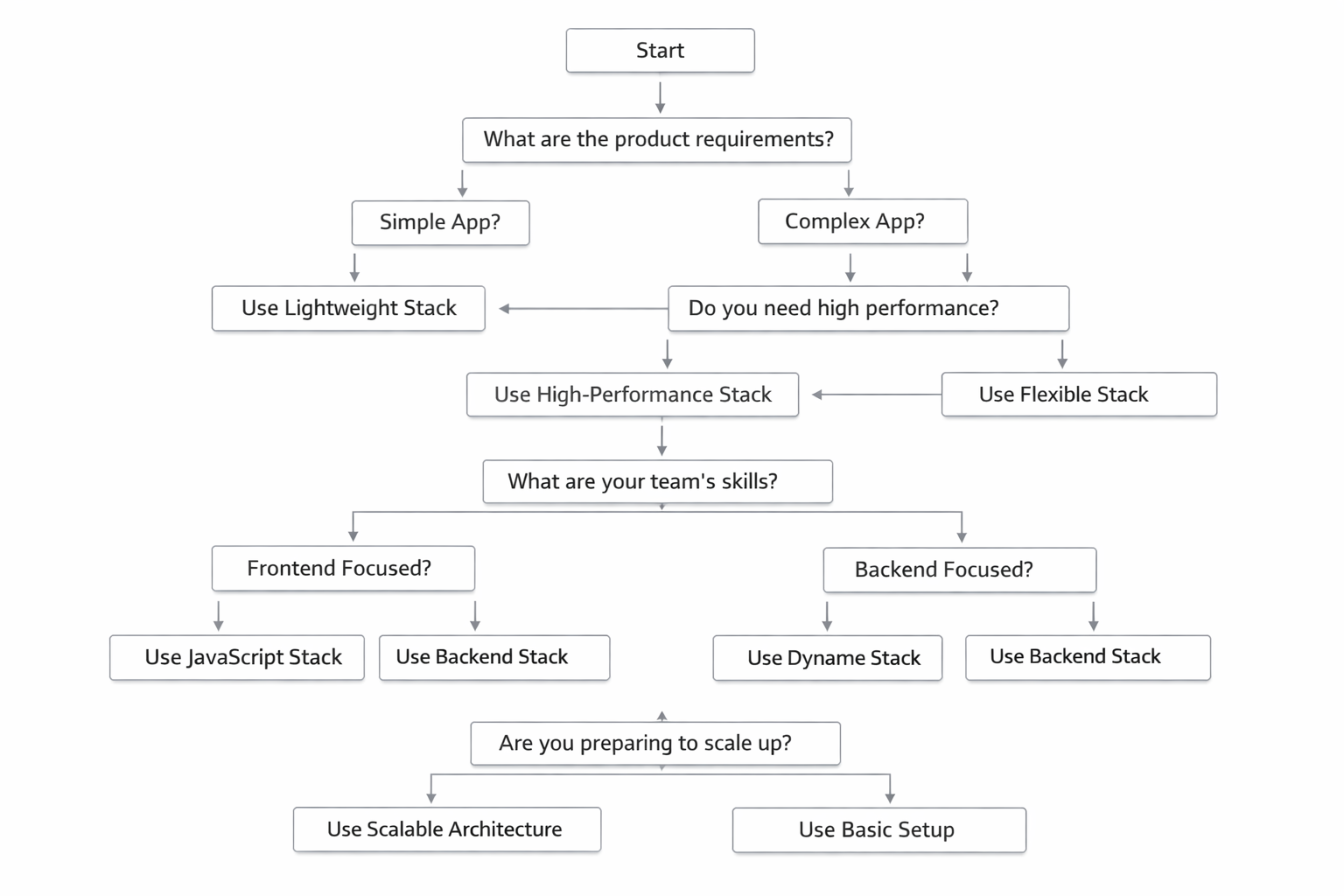
Once these are known, the stack selection process becomes much more objective. You stop asking, “What is best in general?” and start asking, “What best satisfies these constraints with the least complexity?”
3. Current Stack Trends in 2025–2026: TypeScript, Cloud-Native Adoption, and AI-Assisted Development
One of the clearest trends in 2025–2026 is the continued momentum of TypeScript across full-stack development. Teams value it because it improves refactoring safety, clarifies API contracts, and works well across frontend and backend codebases. For new products, a shared language between layers reduces context switching and can simplify hiring. TypeScript does not solve architectural problems, but it does make medium-sized codebases easier to evolve.
Cloud-native adoption is also still rising, but with a more pragmatic tone than in earlier years. Many teams are less interested in adopting cloud-native patterns for their own sake and more interested in managed services, autoscaling, and deployment simplicity. The market has matured: container orchestration, serverless platforms, managed databases, queues, and observability tooling are now mainstream. The trend is not “everything must be microservices,” but rather “use managed infrastructure where it removes undifferentiated heavy lifting.”
AI-assisted development has become a default part of the engineering workflow. Developers increasingly use AI to generate boilerplate, draft tests, accelerate debugging, and explore implementation options. This changes stack selection in subtle ways. Stacks with strong conventions, rich docs, and well-defined interfaces are easier for both humans and AI tools to work with. In practice, AI tends to amplify the strengths of a well-structured stack and the weaknesses of a chaotic one.
At the same time, new product teams are learning that AI features should not automatically dictate a full AI-centric architecture. Many products benefit from targeted AI augmentation—classification, summarization, search, recommendations, extraction—without requiring custom model training or overly complex orchestration. The trend in 2026 is less about “build your own model” and more about integrating AI capabilities where they materially improve the product.
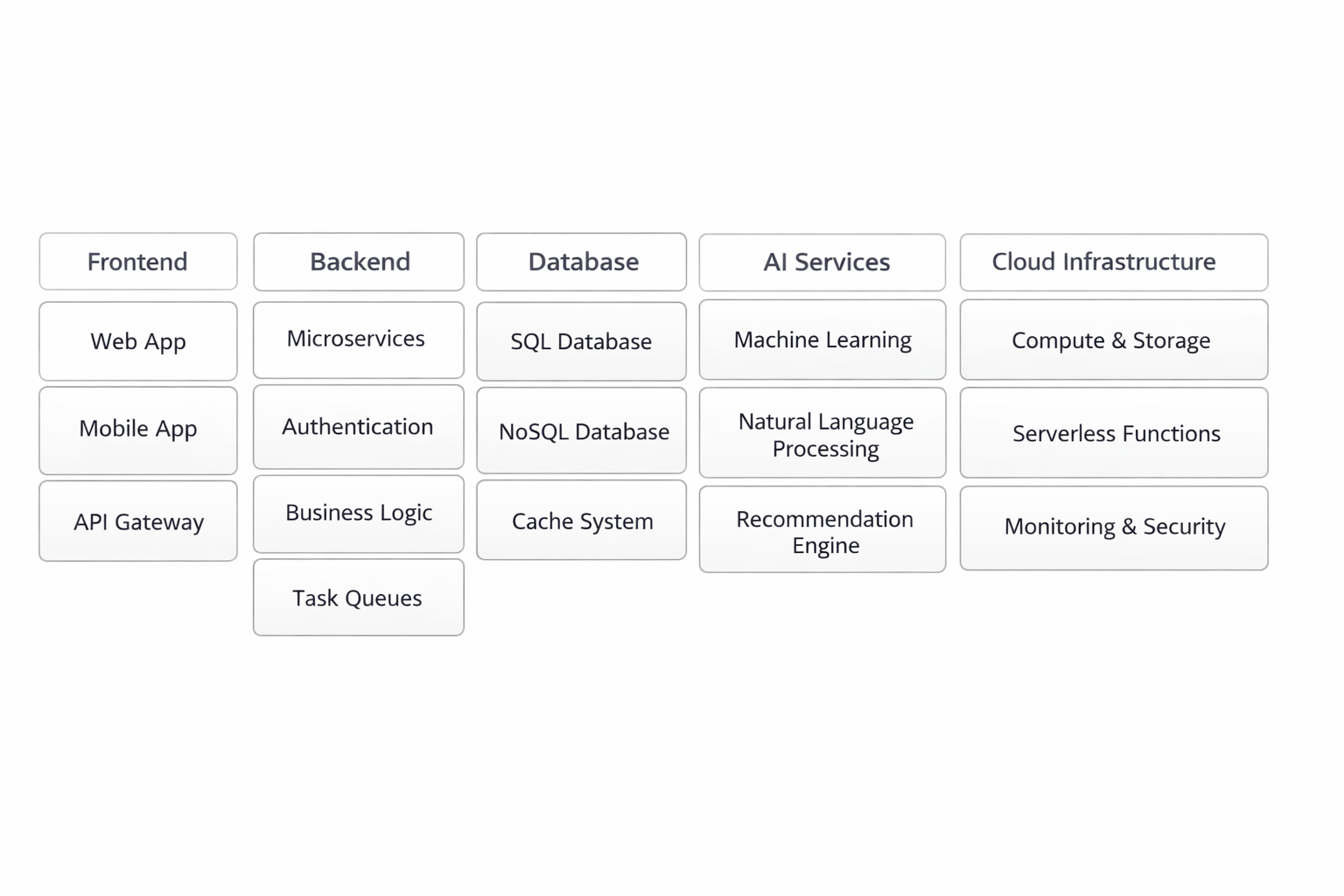
The key takeaway is that current trends should inform, not dominate, your decision. Trend alignment is useful only when it supports speed, maintainability, and user value.
4. Core Selection Criteria: Performance, Scalability, Security, Maintainability, Ecosystem, and Team Expertise
Every stack choice should be evaluated against a consistent set of criteria. The first is performance. Performance is not only about raw speed; it is about whether the stack meets the product’s actual response-time and throughput needs. Many new products do not need exotic performance optimizations. They need predictable latency, sensible caching, efficient database access, and a frontend that feels responsive. If your product is not latency-sensitive, choosing a highly specialized high-performance stack may add complexity without meaningful benefit.
Scalability is broader than handling more traffic. It includes scaling the codebase, the team, the deployment process, and the data model. A stack should support growth without forcing constant re-architecture. Good scalability often comes from clean modular boundaries, reliable deployment practices, and disciplined data access patterns rather than from choosing the “most scalable” infrastructure. In many cases, a well-designed monolith scales further than a prematurely split microservice system.
Security should never be an afterthought. The stack needs to support secure authentication, authorization, secret management, patching, logging, and least-privilege access. If the product handles sensitive data, the ecosystem around the stack matters: security tooling, dependency hygiene, community support, and vendor posture all become important. The more complex the stack, the larger the attack surface and operational burden.
Maintainability is often the most important long-term criterion. It includes readability, testability, convention quality, and how easy it is for new engineers to contribute. A stack with excellent maintainability reduces bus factor and makes refactoring feasible. This is one reason many teams favor strongly opinionated frameworks and managed services over highly bespoke architectures.
Ecosystem maturity matters because no product is built from scratch. You need libraries, integrations, community examples, debugging tools, monitoring support, and hiring familiarity. A mature ecosystem reduces the risk of dead ends.
Team expertise may be the decisive factor. A theoretically optimal stack is not optimal if your team cannot build or support it confidently. The right choice is usually the one that the team can execute on quickly with high quality.
5. Frontend, Backend, and Database Choices: Matching Complexity and Delivery Speed
Frontend selection should follow user experience requirements and team strengths. For many 2026 products, a TypeScript-based frontend framework remains the most practical default because it offers strong developer tooling, componentization, and a large ecosystem. If the product is content-heavy or SEO-sensitive, server rendering and static generation can be important. If it is app-like and authenticated, client-side interactivity may matter more. The decision should be driven by where the complexity actually lives.
For a simple CRUD product, a relatively standard frontend stack can be enough: component library, routing, state management where necessary, and consistent API integration patterns. For a more interactive product—such as a dashboard, collaboration tool, or AI interface—you may need careful state orchestration, streaming responses, and fine-grained performance tuning. Still, the temptation to overcomplicate the frontend early should be resisted.
Backend choices depend heavily on business logic complexity. If the product is mostly API-driven and the team is fluent in JavaScript or TypeScript, using the same language across frontend and backend often simplifies development. If the product has heavy computational workloads, strong concurrency requirements, or complex domain modeling, another backend language may be a better fit. The question is not what is fashionable, but what reduces friction while supporting the product’s core logic.
Database selection is one of the most consequential decisions. For many products, a relational database is the right starting point because it handles structured data, transactions, and relational queries well. If the product needs flexible document structures, event-like data, or rapid schema evolution, a document store may be attractive. If the product is analytics-heavy, a separate warehouse or columnar system may be necessary. In practice, many successful products use a relational database as the source of truth and add specialized systems only when the workload demands it.
The biggest mistake is choosing a database based on vague “future scale” concerns rather than current access patterns. Data modeling should reflect the product’s actual domain, not hypothetical worst cases.
6. Cloud, Hosting, and Infrastructure Decisions: Monolith vs. Microservices, Containers, Serverless, and Managed Services
Infrastructure is where many teams over-engineer. For new products, a monolith is often the right default. That does not mean a codebase without structure; it means a single deployable system with clear internal boundaries. Monoliths are easier to develop, test, deploy, and observe. They reduce distributed-system complexity and allow teams to move quickly while the product is still changing.
Microservices should be introduced only when they solve a real problem. Those problems typically include independent scaling needs, strict team ownership boundaries, or isolation requirements for reliability or compliance. If the team is small, microservices often increase latency, operational overhead, and debugging difficulty without providing enough benefit. The cost of network boundaries, service coordination, and deployment orchestration is usually underestimated.
Containers remain useful when you need portable execution environments, consistent deployment behavior, or more control over runtime packaging. They are a good fit when your team wants predictable deployments without adopting a fully bespoke infrastructure model. However, containers are not mandatory for every product. If a managed platform can deploy your application directly with less operational work, that can be a better starting point.
Serverless is attractive for event-driven workloads, variable traffic, and low-ops teams. It can reduce infrastructure management and cost for spiky or intermittent usage. But serverless introduces its own constraints: cold starts, execution limits, observability complexity, and vendor-specific runtime patterns. It works best when the application is naturally decomposed into request/response handlers, background jobs, and event consumers rather than long-running stateful processes.
Managed services are often the most practical choice for databases, queues, search, auth, monitoring, object storage, and deployment pipelines. They trade some control for much faster delivery and lower operational burden. That tradeoff is usually worthwhile for a new product. The guiding principle should be: own the code that differentiates your product; outsource the infrastructure that does not.
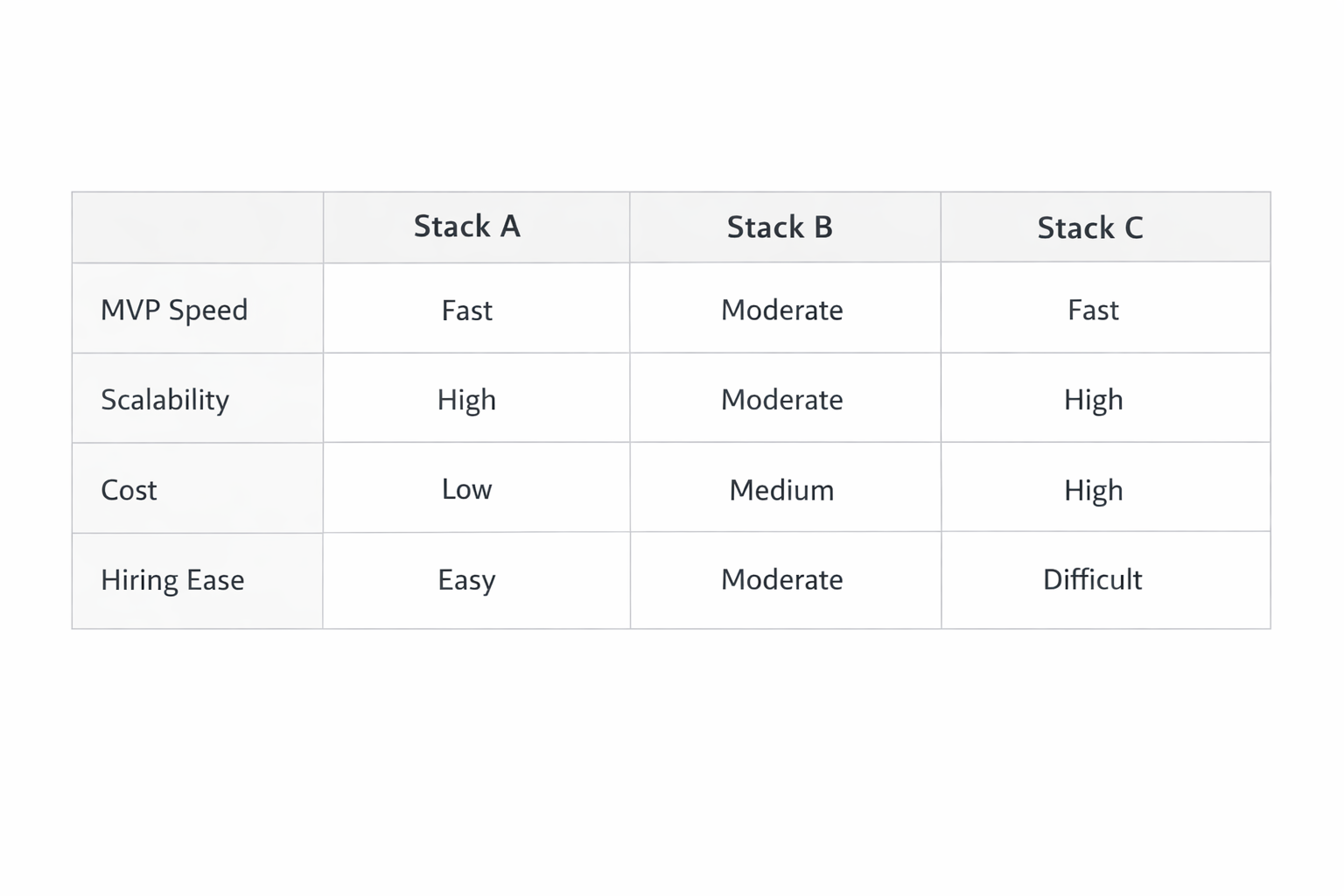
7. AI and Automation Considerations: Where AI Fits and How to Avoid Unnecessary Complexity
AI is now part of product design, but it should be used deliberately. The best use cases are ones where AI improves user value without turning the product into a research project. Common examples include semantic search, summarization, content drafting, entity extraction, classification, support automation, document understanding, and workflow assistance. These features can often be added incrementally using APIs or managed AI services.
The mistake many teams make is treating AI as a reason to redesign the entire stack. In most products, AI should be one subsystem among many, not the foundation of every architectural choice. You usually do not need a separate microservice architecture just because one feature uses an LLM. You do not need to rebuild your data platform from scratch unless AI introduces specific scaling or retrieval requirements.
A good approach is to isolate AI concerns through clear interfaces. For example, keep prompts, retrieval logic, model selection, evaluation, and fallback behavior in a dedicated layer. That makes it easier to swap providers, improve quality, and measure outcomes. It also avoids contaminating core business logic with model-specific code.
Automation can help in other parts of the stack too. CI/CD, testing, code review support, deployment automation, observability alerts, and data validation can all be improved with AI-assisted workflows. These capabilities can reduce toil and improve team velocity, especially for small teams. But automation should reduce cognitive load, not add new systems to maintain.
A useful rule: if the AI component does not materially improve the user experience or internal efficiency, do not force it into the architecture. AI should be additive, not ornamental.
8. Team and Hiring Reality: Build What You Can Support and Hire For
The best stack on paper is not necessarily the best stack in practice. Your team has to build it, support it, debug it, and extend it under pressure. That means stack choice should be grounded in current capability and likely hiring availability. If your founders and first engineers are strongest in TypeScript, a full-stack TypeScript approach often makes sense because it minimizes ramp-up time and maximizes shared understanding.
Hiring speed matters because early teams need to grow quickly without degrading quality. Technologies with broad adoption usually make recruiting easier. They also improve onboarding because more candidates arrive with relevant background knowledge. This can be especially important for startups competing against larger companies for engineering talent.
Supportability is equally important. If a problem occurs at 2 a.m., can someone on the team diagnose it? Do you have logging, tracing, metrics, and runbooks? Can the team safely deploy changes? Can a new engineer understand the codebase in days, not months? A technology that is elegant but opaque can become a liability if only one person truly understands it.
It is also worth thinking about team composition. A small product team may benefit from fewer technologies and fewer layers. A larger team may need better separation of concerns, stronger module boundaries, and more explicit ownership. In either case, consistency is valuable. A stack with too many languages, frameworks, and deployment patterns increases the cognitive load on everyone.
The hiring reality often pushes teams toward widely used, well-documented, general-purpose stacks. That is not conservative for its own sake; it is a rational response to the need for velocity and resilience.
9. Cost, Risk, and Technical Debt: TCO, Lock-In, and Migration Pain
Total cost of ownership is broader than invoice cost. It includes engineering time, operational burden, incident response, vendor fees, training, maintenance, and future migration cost. A stack that looks inexpensive initially may become expensive if it creates a lot of custom code, requires specialist talent, or makes integrations difficult. Likewise, a managed service that appears costly per unit may still be cheaper overall if it saves weeks of engineering effort each quarter.
Vendor lock-in is a legitimate concern, but it should be evaluated realistically. Some degree of lock-in is unavoidable; every stack choice constrains you somehow. The real question is whether the constraints are acceptable relative to the value you get. If a platform dramatically reduces time to market, the tradeoff may be worth it. If the product is likely to move into regulated environments or multi-cloud requirements, then portability becomes more important.
Migration pain is often underestimated because it is invisible at the beginning. The cost of switching grows with data volume, architectural coupling, and accumulated product behavior. To reduce migration pain, favor clear boundaries, standard protocols, good data export options, and modular design. Even if you choose a managed or proprietary service, make sure your business can survive a future change if needed.
Technical debt should be intentional. The question is not whether to incur debt, but where and why. Early products often benefit from shipping with some shortcuts, but those shortcuts should be documented and limited. Avoid structural debt in the core data model, authentication model, and deployment pipeline, because those are expensive to unwind later. Pay down debt that blocks speed or increases risk; tolerate debt that does not yet matter.
A disciplined team treats debt like leverage: useful in the short term, dangerous if unmanaged.
10. Decision Framework and Examples: Practical Stack Picks for Common Product Types
A useful way to choose a stack is to start with the product category and then narrow options based on constraints. The framework below is not a universal prescription, but it is a pragmatic starting point.
MVPs
For a simple MVP, the priority is fast validation. The ideal stack is usually opinionated, cohesive, and familiar to the team. A full-stack TypeScript setup with a relational database and managed hosting is often enough. Add authentication, payments, analytics, and file storage via managed services. Keep infrastructure simple, deploy often, and avoid splitting the system unless the product proves demand.
This choice works well when you need to test a hypothesis, onboard a small user base, or iterate rapidly on product-market fit. It is usually better to have a clean monolith that ships quickly than a distributed system that is “future-proof” but slow to evolve.
SaaS Products
For a B2B SaaS product, you typically need stronger attention to authentication, authorization, auditability, tenancy, and integrations. A relational database is usually the backbone, with a backend that models business logic explicitly and a frontend optimized for dashboard workflows. Managed services for email, billing, observability, and background jobs are often worthwhile.
SaaS products also benefit from clear domain boundaries. Even if you start as a monolith, code organization should anticipate growth in complexity. A modular backend with strong API contracts can make later scaling much easier.
AI Apps
For AI-first products, the stack should support prompt management, retrieval, evaluation, streaming responses, and provider abstraction. The application still needs a conventional backend and database, but it may also require vector search, object storage, caching, and background processing. The main design goal is to keep AI-specific components isolated so that you can iterate quickly as model quality, cost, and latency change.
The mistake to avoid here is overbuilding a custom AI platform before you have enough product usage to justify it. Start with managed APIs and simple orchestration. Add sophistication only where it improves accuracy, reliability, or cost efficiency.
Data-Heavy Platforms
For data-heavy products, choose the stack based on ingestion, transformation, query patterns, and freshness requirements. You may need a transactional source of truth, a streaming or batch pipeline, and an analytical store. The frontend may be simple, but the backend and infrastructure need to handle large data volumes reliably. Observability, schema evolution, lineage, and performance tuning become central concerns.
In these systems, the most important choice is often not the framework but the data architecture. A straightforward application stack paired with the right ingestion and storage strategy is usually better than a flashy web stack with weak data foundations.
A Simple Decision Flow
Define the product’s core user journey.
Identify the top non-negotiable constraints.
Choose the simplest stack that satisfies those constraints.
Prefer managed services over custom infrastructure unless differentiation requires otherwise.
Optimize for team speed and hiring availability.
Introduce complexity only when measurable product needs justify it.
This is the most reliable way to avoid premature architecture while still building a foundation that can grow.
Conclusion: Make the Stack Serve the Product, Not the Other Way Around
Choosing the right tech stack in 2026 is less about picking the trendiest tools and more about making disciplined tradeoffs. The best stack is the one that fits the product’s goals, supports the team’s execution style, and leaves room for growth without creating unnecessary complexity. Start with the product definition, not the tooling. Let business requirements, user needs, and MVP scope shape your architecture choices.
As a general pattern, favor proven, well-supported technologies, especially when speed and hiring matter. Use managed services where they reduce operational burden. Avoid microservices unless the product’s scale or organizational structure truly demands them. Treat AI as a powerful capability layer, not a reason to redesign everything. And always evaluate the long-term costs of maintainability, migration, and technical debt alongside short-term delivery speed.
The best stack is not the most sophisticated one. It is the one that helps your team ship the right product faster, with fewer surprises, and with a realistic path to evolution as the business grows. If you get that balance right, your technology becomes an advantage instead of a constraint.