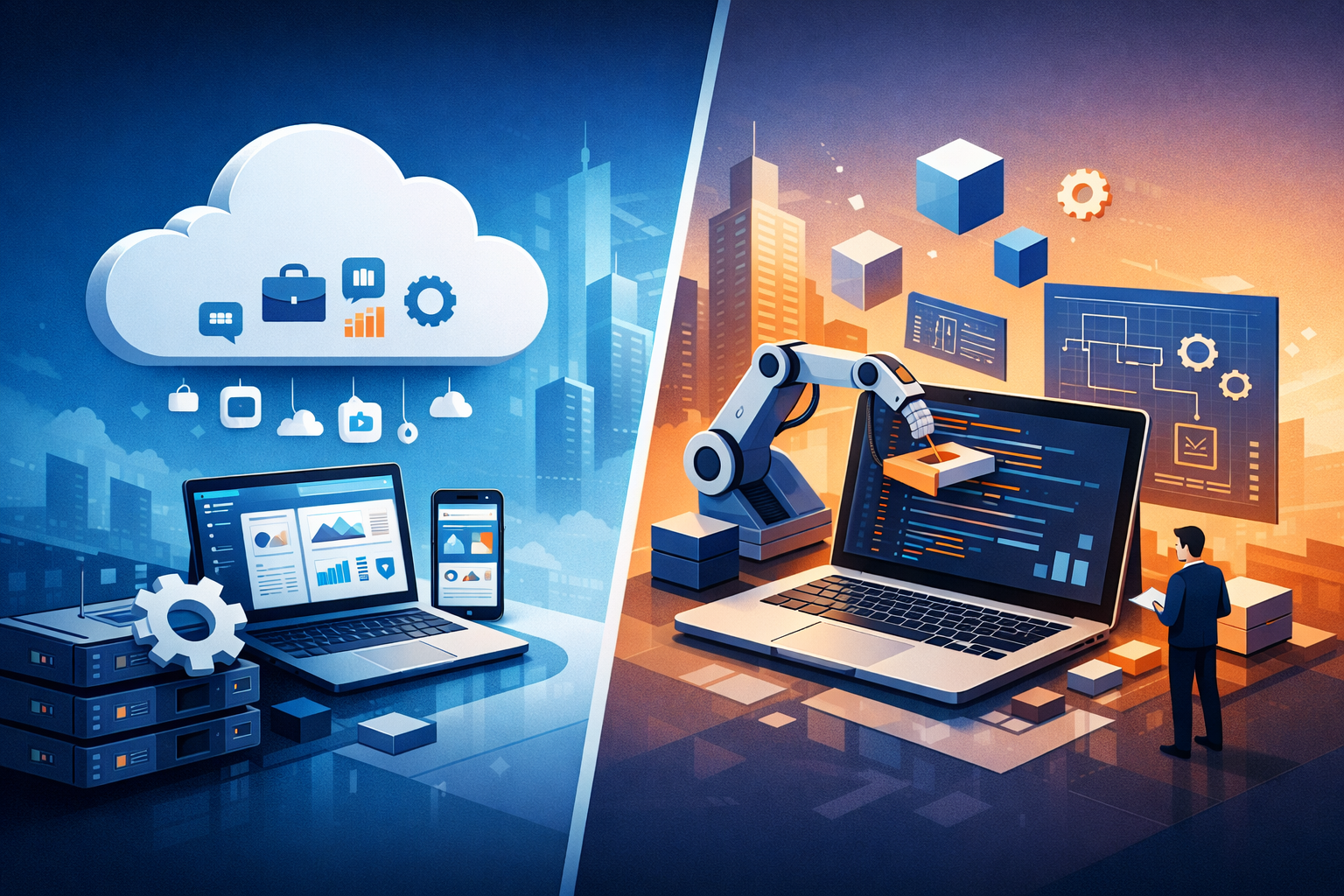
Buy vs Build: When to Choose SaaS Over Custom Software in 2026
The “buy vs build” decision has always mattered, but in 2026 it has become a strategic inflection point rather than a simple procurement choice. Software teams are now operating in a market shaped by faster product cycles, accelerating AI adoption, tighter security expectations, and rising pressure to deliver measurable business outcomes with fewer engineering resources. In that environment, choosing SaaS versus custom software affects not just delivery speed, but also long-term flexibility, governance, and competitive positioning.
What changed is the baseline. A few years ago, many organizations treated SaaS as a convenience layer for commoditized functions and custom software as the default for anything important. That logic no longer holds. Modern SaaS products are increasingly AI-enabled, deeply integrated, and enterprise-ready, while custom development has become more expensive to sustain because teams must now account for model integration, data pipelines, compliance controls, observability, and ongoing product maintenance. At the same time, software buyers are more sophisticated and more selective, with market research showing that buyers evaluate vendors more carefully, prioritize security and AI capabilities, and expect measurable value earlier in the purchase cycle.
This post breaks down how to make the decision in 2026 using practical criteria: speed, cost, differentiation, risk, integration, data, security, and governance. It also provides a decision framework you can apply to real projects—whether you are a startup trying to move fast, an enterprise modernizing legacy workflows, or a regulated organization balancing innovation with control.
1. Introduction: Why the buy-vs-build decision is more important in 2026
The buy-vs-build question is more important in 2026 because software is no longer just an internal productivity tool; it is part of the operating model. Teams rely on software to route decisions, automate workflows, analyze customer behavior, enforce policy, and increasingly embed AI into everyday work. That means the software stack is now a source of leverage, but also a source of risk. A poor decision can slow delivery, create security exposure, and harden technical debt into business debt.
In 2026, the pressure is amplified by the state of enterprise software markets. Platform consolidation continues, AI-native vendors are reshaping categories, and software buyers are more value-conscious than before. Enterprise leaders are also dealing with the reality that software purchases are no longer one-time events; they are lifecycle commitments involving procurement, integration, compliance, training, governance, and renewal negotiations. At the same time, internal engineering capacity remains finite, and many teams are already using much of that capacity on core product work, data infrastructure, and AI experimentation.
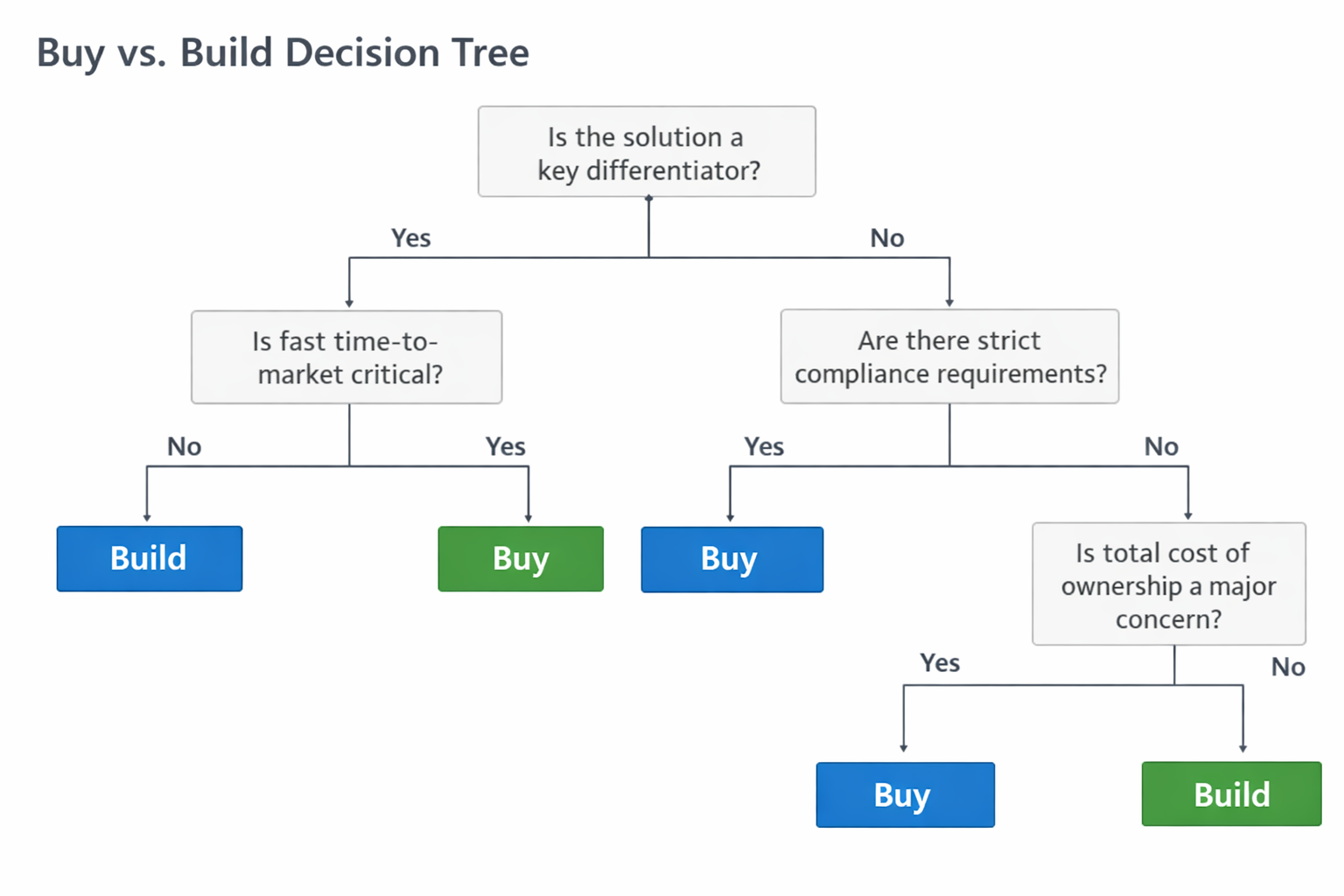
This makes the decision less ideological and more portfolio-based. Buy when the market offers a mature capability that is not a source of differentiation. Build when the capability is core to strategy, deeply tied to proprietary data, or constrained by unique regulatory or operational requirements. Blend when the problem sits somewhere in the middle. In 2026, the right answer is rarely “always buy” or “always build.” It is choosing the minimum custom surface area that preserves competitive advantage while avoiding unnecessary reinvention.
The strongest organizations are now treating buy-vs-build as an architectural and financial decision, not just a product decision. They assess business value, integration complexity, compliance burden, and long-term ownership cost before committing engineering resources. That discipline matters because the most expensive software is rarely the one with the biggest license fee; it is the one that quietly consumes years of engineering time, creates brittle dependencies, and distracts teams from the work that actually differentiates the business.
2. Market trends and latest statistics shaping software buying decisions
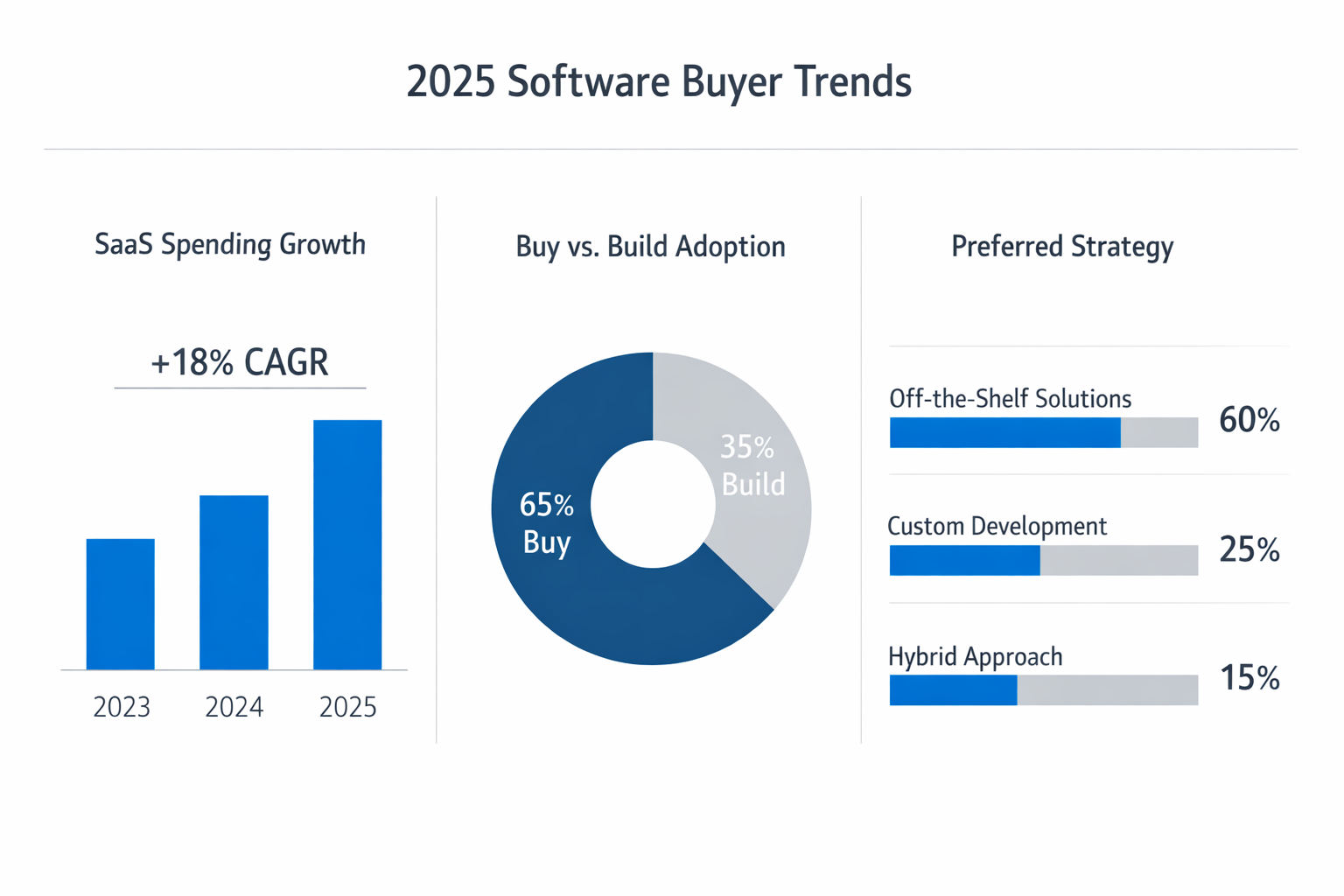
The software market in 2026 is being shaped by a few durable trends: AI integration is becoming table stakes, SaaS ecosystems are expanding, and buyers are increasingly cautious about vendor concentration and subscription sprawl. Gartner’s 2025 buyer research and 2026 market updates indicate that software vendors are competing in a more consolidated and AI-influenced landscape, while Gartner also notes a return of buyer leverage as AI disruption and market volatility create pressure on pricing and contract terms. (gartner.com)
One of the clearest market signals is that buyers now expect AI features in core applications, not just standalone AI tools. Gartner’s 2025 and 2026 research on software markets and buyer trends suggests that AI-native vendors and AI-enhanced incumbents are changing competitive dynamics, especially in enterprise applications. McKinsey’s 2025 AI research also shows organizations are pushing to redesign workflows, not merely add AI as a thin layer on top of existing systems. (gartner.com)
SaaS adoption is also continuing to grow because organizations value agility, scalability, and faster deployment. Forrester’s 2025 technology landscape report says enterprises continue to expand SaaS use while remaining wary of subscription cost growth, lock-in, and the risks of outsourcing critical functions. That tension is central to modern software strategy: SaaS is attractive precisely because it reduces time-to-value, but the larger the business dependency, the more important governance and exit planning become. (forrester.com)
Meanwhile, buyer behavior has become more rigorous. Gartner’s research on the software buyer journey shows that decision-makers are using more sources, more evaluation criteria, and more scrutiny before purchasing. In practical terms, that means vendors are under pressure to prove value sooner, which favors SaaS in commodity categories and favors custom builds only when the organization’s requirements are genuinely unique. (gartner.com)
Another important trend is that internal AI and software engineering teams are prioritizing speed and reuse. McKinsey’s 2025 State of AI research highlights that organizations are seeing cost benefits from AI use cases in software engineering and IT, but the same research also emphasizes that value capture depends on data, operating model, and scaling discipline. That reinforces a key point: building software is not just coding; it is also building the operational system to support it. (mckinsey.com)
3. Core decision criteria: speed, cost, differentiation, and risk
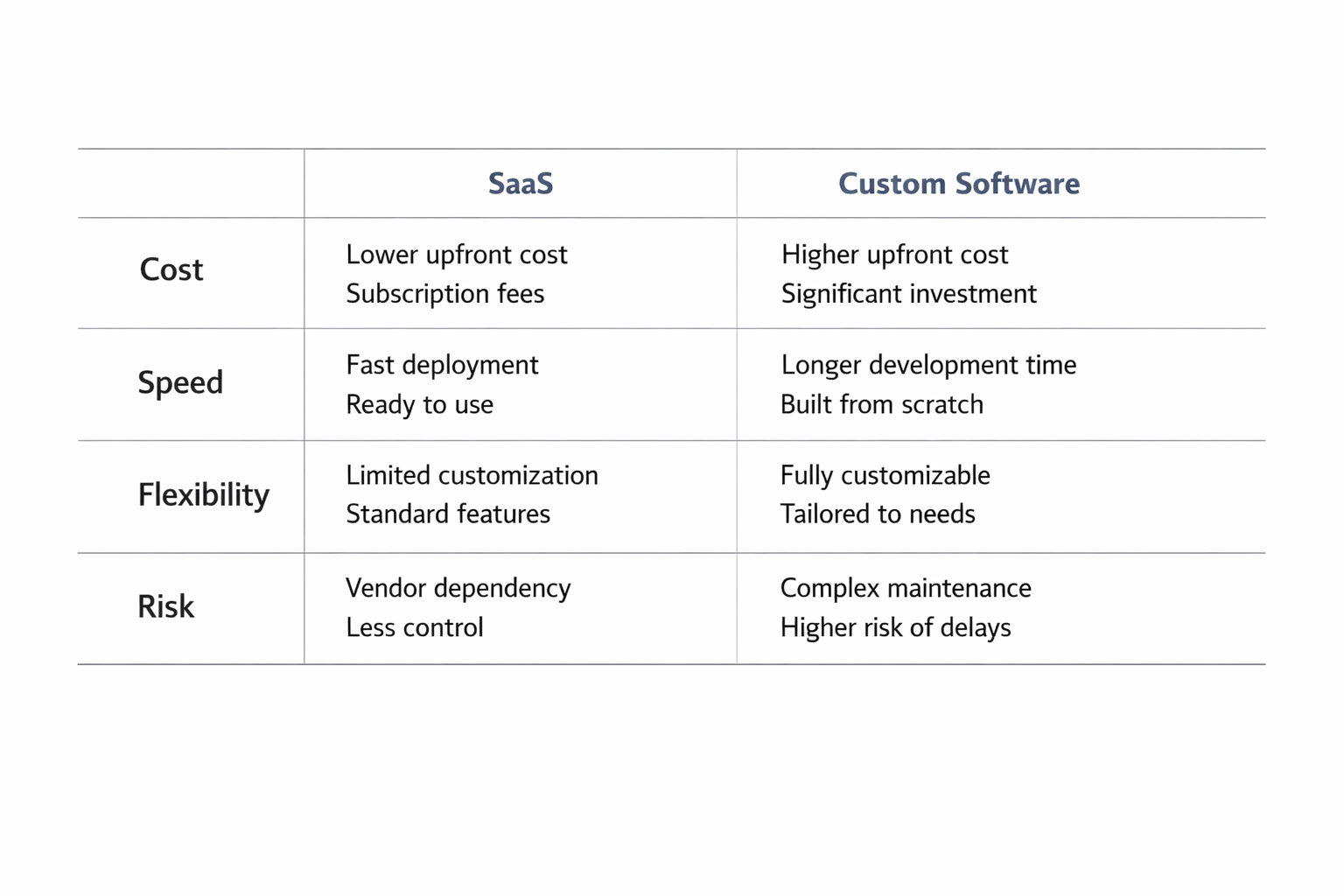
A practical buy-vs-build decision starts with four questions: How fast do we need value? What is the true cost? Is this capability a differentiator? What risks are we taking on? These four criteria are usually enough to eliminate most bad decisions before they happen.
Speed is often the most visible factor. SaaS usually wins when a business needs a capability immediately, especially for common functions like collaboration, CRM, ticketing, workflow automation, analytics dashboards, or identity-adjacent tooling. Building can take months before a usable version exists, and even longer before the system is stable enough for broad adoption. In 2026, where product and market cycles are faster, delay is often more expensive than license cost.
Cost must be evaluated beyond initial spend. SaaS looks expensive only if you compare subscription fees against a developer team’s salary in a simplistic way. Custom software requires ongoing engineering, QA, security hardening, infrastructure, observability, incident response, documentation, and upgrades. If the system is likely to evolve for years, the cost curve can rise sharply after launch. The right comparison is not “license versus build estimate,” but “subscription versus total lifecycle ownership.”
Differentiation determines whether software should be standardized or strategic. If the workflow is not a source of competitive advantage, SaaS is usually the default. If the workflow encodes proprietary logic, customer experience, risk controls, or a unique operating model, building may create durable value. The key test is simple: if a competitor could buy the same tool and achieve similar results, you probably do not need to build it.
Risk includes more than security. It also includes vendor dependency, migration risk, compliance exposure, operational continuity, and knowledge concentration. SaaS shifts some risks to the vendor, but it introduces others, such as lock-in or roadmap dependence. Building shifts control inward, but it increases responsibility and the burden of maintaining resilience over time.
4. When SaaS is the better choice: common use cases and signals
SaaS is the better choice when the need is common, the process is not strategically unique, and the organization wants to reduce time-to-value. The best SaaS candidates are usually capabilities that many companies need but few companies truly differentiate on.
Typical examples include HR systems, payroll, expense management, help desk platforms, marketing automation, document management, email security, analytics tooling, and standard collaboration workflows. These categories have well-established patterns, broad vendor competition, and relatively mature feature sets. In such cases, building custom software often adds complexity without adding meaningful business advantage.
There are also behavioral signals that favor SaaS. If your team is asking for a system to solve a workflow that already exists in many products, SaaS is usually the right starting point. If the use case requires quick deployment across multiple teams, SaaS can reduce adoption friction because it comes with ready-made admin tools, permissions models, and training patterns. If the organization is under pressure to reduce engineering load, SaaS allows developers to focus on customer-facing or revenue-generating work instead of internal platform maintenance.
SaaS is also compelling when the business process changes often, but not in a way that is unique. Vendors absorb much of the maintenance burden when regulations, standards, or user expectations evolve. That matters in categories where updating UX, mobile support, AI features, or compliance tooling is constant. In a build scenario, the company becomes responsible for keeping pace with all of that change.
Another strong SaaS signal is when the business needs access to a mature ecosystem. Modern SaaS tools often ship with integrations, APIs, admin automation, marketplace add-ons, and governance controls that would take significant effort to recreate internally. In many real-world environments, these ecosystem benefits matter as much as the core product itself.
The best rule of thumb is this: buy when the problem is important but not differentiating, when the market is mature, and when speed and operational leverage matter more than deep customization. In 2026, that applies to a larger share of software needs than many organizations assume.
5. When custom software still wins: strategic, complex, or regulated needs
Custom software still wins when the system is part of your competitive moat, when the workflow is unusually complex, or when regulatory and operational constraints make generic SaaS a poor fit. This is where build decisions earn their keep.
The strongest case for building is strategic differentiation. If a software capability directly shapes product experience, pricing, personalization, proprietary automation, or decision intelligence, then owning the logic can create compounding advantage. For example, a fintech platform may build underwriting logic, a logistics company may build routing optimization, or a marketplace may build dynamic matching and ranking systems. In each case, the software is not just supporting the business; it is the business.
Custom software also becomes attractive when the process is unusually specific. Some organizations have workflows that are shaped by legacy systems, unusual approval chains, industry-specific terminology, or unique data models. Forcing those workflows into a generic SaaS tool can create workarounds, shadow processes, and hidden inefficiency. In those cases, “configurable” SaaS often becomes expensive customization by another name, just spread across admin panels and integration scripts rather than source code.
Regulated environments are another major reason to build. Industries such as healthcare, financial services, defense, energy, and public sector operations may require precise controls over data locality, auditability, retention, access policies, and model behavior. SaaS vendors can absolutely serve these markets, but the more specific the control requirement, the more likely you are to need custom workflows or a hybrid architecture. The question is not whether SaaS can be secure; it is whether the vendor’s security model maps cleanly to your compliance obligations.
Building can also make sense when the company has exceptional engineering maturity and can amortize platform investment across many use cases. If you have a strong internal platform team, good DevOps discipline, mature security practices, and a stable roadmap, custom software can be leveraged as a reusable asset rather than a one-off cost center. But this only works when the organization is disciplined enough to treat software as a product with lifecycle ownership, not as a project with a finish line.
In short, build when the software is central to differentiation, too specialized for the market, or constrained by requirements that SaaS cannot satisfy cleanly without creating new risk.
6. Total cost of ownership: license fees vs development, maintenance, and opportunity cost
The most common mistake in buy-vs-build decisions is comparing subscription cost to development cost as if those were the only variables. They are not. Total cost of ownership includes build effort, maintenance, infrastructure, security, support, upgrades, and the opportunity cost of using skilled people on the wrong work.
SaaS costs are visible and recurring. You pay subscriptions, implementation fees, integration costs, and sometimes usage-based charges. Those costs can rise over time, especially as vendors introduce premium tiers, AI add-ons, storage fees, or higher per-seat pricing. The upside is predictability: the vendor absorbs much of the product maintenance burden, and the cost often scales with usage.
Custom software costs are more distributed and therefore easier to underestimate. The initial build is only the start. Once a system is in production, you need bug fixes, feature updates, security patches, observability, backups, incident response, infrastructure tuning, and periodic refactoring. If AI features are involved, you also need to maintain model access, prompt or workflow orchestration, evaluation pipelines, guardrails, and data quality controls. None of this is free, and all of it compounds over time.
There is also opportunity cost, which is often the largest hidden expense. Every engineer assigned to an internal tool is an engineer not building customer value, reducing churn, improving margins, or supporting strategic growth. That trade-off becomes especially important when engineering capacity is scarce. In many organizations, the real question is not whether a custom system can be built, but whether it should be built by the people you have.
A useful way to think about TCO is to compare three curves:
SaaS license curve — lower upfront effort, recurring operating expense.
Build curve — higher upfront investment, ongoing maintenance.
Delay curve — the cost of waiting for an internal solution while the business need remains unsatisfied.
In many cases, SaaS wins because it collapses the delay curve and reduces the maintenance curve, even if the long-term subscription total appears higher on paper. Custom software wins when the recurring license curve would outgrow the value of ownership, or when the capability generates enough strategic advantage to justify the sustained engineering cost.
The right financial model should include at least a three- to five-year horizon and should account for implementation, support, integrations, vendor management, and retirement costs. If the analysis is limited to year-one expense, it is not a real TCO analysis.
7. Integration, data, and AI considerations in modern SaaS adoption
In 2026, integration and data strategy matter as much as feature fit. A SaaS product that looks perfect in a demo can become a liability if it cannot connect cleanly to your identity, data, analytics, and workflow layers. The most important question is not “Does the tool work?” but “Can it work inside our operating environment?”
Integration starts with identity and access. Organizations need SSO, SCIM provisioning, role-based access control, audit logs, and lifecycle management. Without those basics, SaaS adds administrative overhead and security risk. Beyond identity, the system must connect to upstream and downstream workflows such as ERP, CRM, customer support, data warehouses, event buses, and automation platforms. If integration requires fragile point-to-point scripts, the hidden maintenance cost can erase SaaS’s advantage.
Data is the next major concern. SaaS adoption increasingly depends on whether an organization can use its own data effectively inside the vendor platform without losing control over governance, portability, or quality. Teams should understand what data leaves the environment, how it is stored, whether it is used for training, how it is segmented, and how it can be exported. This is especially important when the SaaS vendor offers AI features that ingest or summarize proprietary information. Data boundaries must be explicit.
AI raises the stakes further. Modern SaaS products increasingly include copilots, automated recommendations, agentic workflows, and generative interfaces. That can create major productivity gains, but it also introduces new dependencies and uncertainties. McKinsey’s 2025 AI research shows that organizations seeing the most value are those redesigning workflows and building the operating model required to scale AI, not simply turning on features. Gartner’s 2025 research on AI agents also suggests that organizations are still early in maturity and should avoid overcommitting to a single-vendor AI strategy too soon. (mckinsey.com)
For buyers, the implication is clear: evaluate AI-enabled SaaS on both capability and controllability. Ask whether the AI feature is optional, configurable, auditable, and aligned to your data governance policies. If the vendor’s AI creates a black box that you cannot monitor or constrain, the software may be difficult to trust in production.
The strongest SaaS implementations in 2026 treat integration and data design as first-class architecture concerns. They do not just connect systems; they define how information moves, who can access it, and where AI is allowed to act.
8. Security, compliance, vendor lock-in, and governance trade-offs
Security, compliance, vendor lock-in, and governance are the trade-offs that most often determine whether SaaS adoption scales or stalls. These topics are also where superficial analysis causes the most damage.
Security is often assumed to favor build because “we control the code.” That is only partly true. A custom system can be secure, but only if the organization has mature secure development practices, patch management, monitoring, access control, and incident response. SaaS vendors often have stronger operational security than an individual customer could build alone, especially for standard enterprise controls. However, the customer still owns configuration, identity, data classification, and usage governance.
Compliance is even more nuanced. SaaS vendors can help satisfy regulatory requirements through certifications, logging, encryption, and contractual commitments, but compliance responsibility is rarely outsourced completely. The organization still needs to ensure the tool’s controls match internal policy and external obligations. For highly regulated workloads, legal, security, and procurement teams should review not only the vendor’s posture but also the exact data flows, retention settings, subprocessors, and AI usage terms.
Vendor lock-in is the biggest long-term concern with SaaS. Lock-in is not just about pricing; it is about operational dependency, proprietary data models, unique workflows, and the cost of migration. A system becomes sticky when it stores business logic, workflow history, and reporting assumptions in formats that are hard to export. That is why architectural exit planning matters. A well-designed SaaS strategy should preserve data portability, use standard interfaces where possible, and avoid embedding irreversible business logic in the vendor layer unless the value is clear.
Governance is the discipline that makes SaaS scalable. Without governance, SaaS sprawl leads to duplicated functionality, inconsistent security settings, redundant licenses, and fragmented data ownership. The more SaaS you buy, the more important it becomes to define ownership, approve categories, manage renewals, and maintain an application inventory. This is especially true in 2026, when AI features can quietly turn a simple subscription into a strategic data-sharing decision.
9. A practical decision framework: build, buy, or blend
A good decision framework should be simple enough to use in a real planning meeting and rigorous enough to prevent regret. The most effective approach is to classify each candidate system into one of three categories: buy, build, or blend.
Step 1: Classify the business value
Ask whether the capability is:
Commodity: common across most companies and low differentiation
Operational: important internally but not a competitive moat
Strategic: directly tied to customer value or market advantage
Commodity and many operational systems should usually be bought. Strategic systems deserve deeper scrutiny and often lean toward build or blend.
Step 2: Score the constraints
Evaluate:
Time-to-value
Engineering effort
Integration complexity
Data sensitivity
Regulatory burden
Custom workflow depth
AI dependence
Migration and exit cost
If multiple constraints are high, a pure SaaS approach may create more friction than value.
Step 3: Decide the ownership model
Use this decision rule:
Buy when the system is standard, the vendor ecosystem is mature, and differentiation is low.
Build when the workflow is proprietary, the data is unique, or the capability is core to the business model.
Blend when the core logic should be owned internally but non-core functions can be outsourced.
Blend is often the most underrated option. For example, an organization might buy a SaaS platform but build custom services around it for orchestration, analytics, or domain-specific rules. Or it might build the customer-facing logic while using SaaS for identity, billing, support, and collaboration. This reduces custom surface area while keeping strategic control where it matters.
Step 4: Design for reversibility
No matter which path you choose, preserve optionality:
Keep data exportable
Avoid proprietary dead ends where possible
Minimize hard-coded business logic inside vendor-only systems
Document workflows and dependencies
Review renewal and migration paths before implementation
A simple rule of thumb
If replacing the software would not materially change your competitive position, buy it. If replacing it would be expensive because it encodes your advantage, build it. If only part of the system is strategic, blend it.
10. Conclusion: how to make a future-proof software strategy
A future-proof software strategy in 2026 is not about choosing SaaS or custom software once and treating that choice as permanent. It is about building a decision-making model that can adapt as markets, AI capabilities, and regulatory expectations evolve. The best organizations are pragmatic: they buy what is mature, build what is differentiating, and blend where control and speed both matter.
The key lesson is that software ownership should follow strategic value, not habit. SaaS is now strong enough to handle far more enterprise needs than it used to, especially where speed, reliability, and ecosystem depth matter. But custom software still has an important role when the problem is unique, core to business advantage, or constrained by governance requirements that generic tools cannot satisfy cleanly.
If you want to make the right call, do not start with ideology. Start with business impact, then evaluate TCO, integration, data, security, and lock-in. The organizations that get this right will move faster, spend smarter, and keep their engineering teams focused on the work that truly matters. In 2026, that is what a durable software strategy looks like.