
Beyond the Careers Page: How Modern Tech Teams Attract, Evaluate, and Grow Talent in the AI Era
The hiring playbook for tech teams is overdue for a reset.
For years, many companies treated recruiting as a marketing problem: publish a polished careers page, list a few perks, post openings on job boards, and wait for the right engineers to apply. That approach no longer works well enough—especially in a market shaped by remote work, talent scarcity, stronger candidate expectations, and the rapid adoption of AI tools across the software lifecycle.
Today, candidates are evaluating more than compensation and brand recognition. They want to understand how teams build software, how decisions are made, whether managers can help them grow, and whether the work itself is technically interesting. At the same time, companies are rethinking what “good engineering” means when AI can draft code, summarize tickets, accelerate testing, and reshape workflows. The best teams are not trying to hire around AI. They are designing hiring, onboarding, and team systems that assume AI is part of the operating model.
This means modern talent strategy must extend well beyond the careers page. It needs to connect employer positioning, interview design, engineering culture, learning pathways, and organizational structure into one coherent system. Companies that get this right will move faster, reduce hiring risk, and build teams that can adapt as AI changes the nature of delivery.
1. The hiring landscape has changed: why tech teams need a new talent strategy
The old hiring model assumed a fairly stable market: candidates were plentiful, remote work was an exception, technical roles were easier to compare, and the interview process could be long without much consequence. That environment is gone. Now candidates can often compare multiple offers quickly, assess a company’s technical reputation through GitHub, blog posts, open-source contributions, and employee commentary, and decide within days whether an opportunity is worth pursuing.
That shifts talent strategy from a reactive recruiting function to a strategic capability. Tech teams need to think like product teams: define the target audience, understand the value proposition, remove friction from the journey, and measure outcomes. The real question is not “How do we fill this role?” but “How do we create a system that consistently attracts and retains the kind of engineers we need?”
A strong talent strategy begins with segmentation. A platform engineer, a product-minded full-stack engineer, and an ML infrastructure engineer may all be “software engineers,” but they are motivated by different problems, growth paths, and signals of quality. A single generic hiring message will not resonate with all of them. Companies need role-specific narratives that explain what kinds of problems are solved, what architectural constraints exist, what level of autonomy the engineer has, and how the team collaborates.
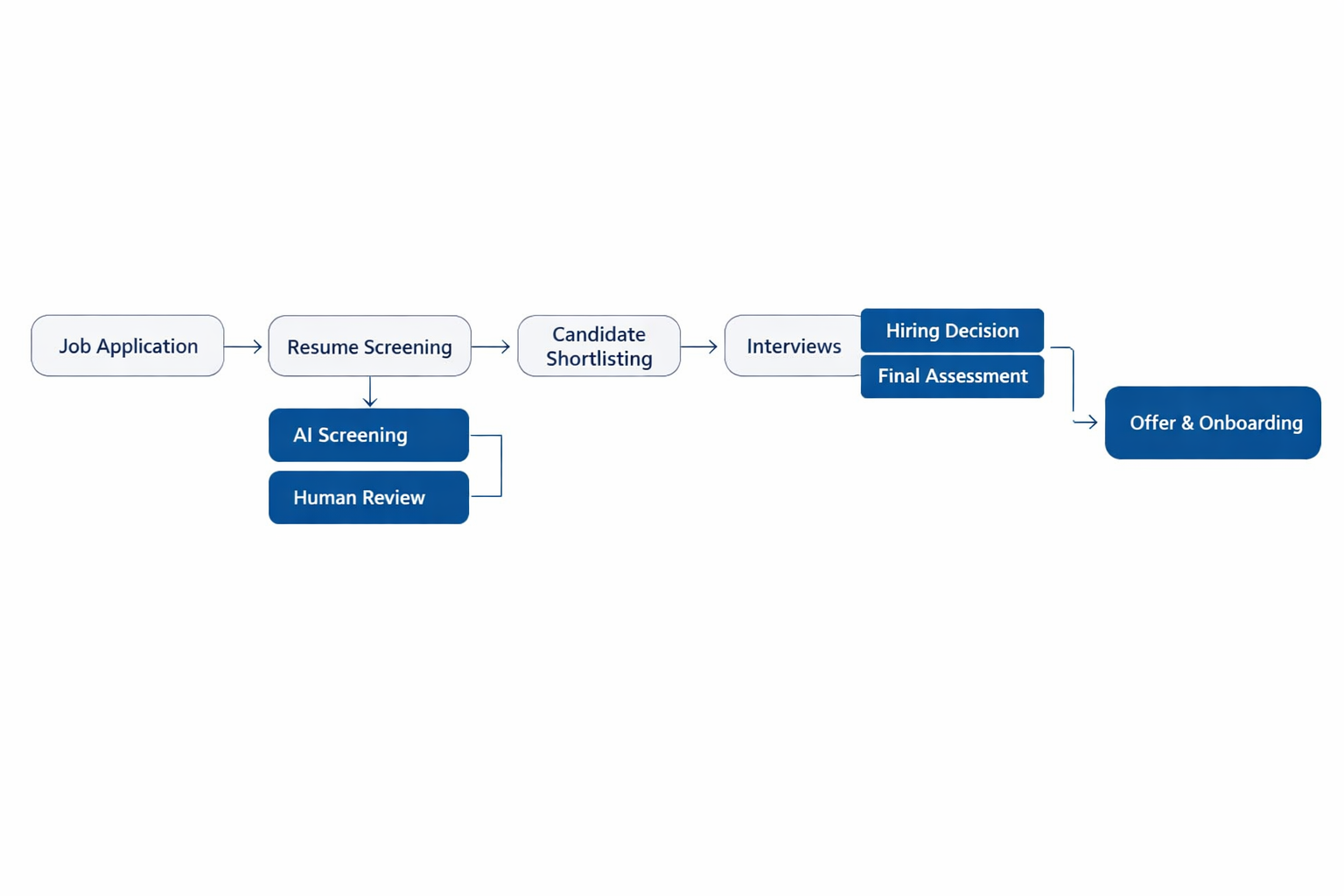
It also requires alignment across functions. Recruiting cannot compensate for unclear engineering leadership, weak management, or vague job scopes. If candidates discover that the team is overloaded, the roadmap is unstable, or expectations are unspoken, the hiring funnel becomes leaky no matter how polished the branding is. In the AI era, talent strategy is not just about sourcing. It is about operational truth: making the actual work visible, understandable, and credible.
2. What candidates actually value now: clarity, growth, flexibility, and real engineering problems
Most strong candidates are not choosing jobs based on generic promises. They are looking for clarity. They want to know what the team is building, why it matters, and what their day-to-day experience will likely feel like. Ambiguity can be exciting in a startup context, but when it becomes a substitute for honest communication, candidates interpret it as risk.
Clarity starts with the role itself. Vague job descriptions such as “wear many hats” or “work in a fast-paced environment” tell candidates very little. Better descriptions explain the product stage, the technical stack, the primary challenges, the scope of ownership, and the shape of collaboration with product, design, QA, or infrastructure teams. Candidates are also paying attention to whether the company can articulate tradeoffs. Mature teams can explain what they optimize for, what they are willing to compromise on, and where the technical debt lives.
Growth is another major differentiator. Talented engineers want more than a title ladder. They want evidence that they can learn, deepen expertise, and expand influence without necessarily becoming people managers. That means companies should be able to describe mentorship practices, code review culture, internal learning opportunities, technical design participation, and how promotions are actually decided. If those mechanisms are undocumented or inconsistent, candidates notice.
Flexibility still matters, but not in a superficial “remote-friendly” sense. Candidates are evaluating whether the team respects deep work, time zones, caregiving responsibilities, and asynchronous collaboration. The strongest signals are operational: well-run documentation, thoughtful meeting discipline, and workflows that do not rely on constant synchronous presence.
And then there is the work itself. Engineers increasingly want to solve real problems, not just maintain a backlog of ambiguous tickets. They are drawn to systems with meaningful complexity: scale, reliability, latency, data quality, security, developer experience, AI integration, or product experimentation. The best teams explain their hard problems clearly. They do not oversell perfection. They make the engineering challenge legible.
In practice, this means candidates are attracted to organizations that look honest, technically serious, and growth-oriented. The careers page is only one surface. What matters more is whether the company can prove it understands engineers as professionals who care about craft, autonomy, and mastery.
3. AI is reshaping software work, not replacing the need for strong engineers
There is a persistent misconception that AI reduces the need for engineering talent. In reality, AI changes the composition of the work. It compresses some tasks, expands others, and raises the value of judgment. Engineers are not disappearing; the best ones are becoming more important because systems still need architecture, verification, integration, and accountable decision-making.
AI can accelerate boilerplate generation, test scaffolding, documentation drafts, log analysis, code search, and even some forms of prototype development. That does not eliminate engineering skill. It shifts attention toward problem framing, system design, quality assurance, security, observability, and product alignment. If code can be produced faster, the bottleneck becomes evaluating whether the code is correct, maintainable, and safe to ship.
This is why strong engineers remain essential. The critical skill is no longer merely writing code from scratch. It is understanding how to use AI tools effectively without outsourcing judgment. Engineers need to know when to trust generated output, when to challenge it, and how to structure workflows so AI improves throughput without introducing hidden risk. That requires deep technical intuition.
The AI era also makes domain knowledge more valuable. A good engineer can prompt a model to generate an implementation. A great engineer knows how that implementation fits into an existing architecture, what failure modes matter, and how it affects product behavior in production. Teams that understand this will hire for systems thinking, not just syntax fluency.

This has implications for hiring criteria. Teams should evaluate candidates on debugging ability, tradeoff analysis, code review judgment, product sense, and collaboration under uncertainty. They should also look for evidence that candidates can work productively with AI tools while maintaining high standards. In other words, the ideal engineer is not someone who resists AI, nor someone who blindly embraces it. It is someone who treats AI as an amplifier of engineering discipline.
4. Rethinking interview design: faster, fairer, and more predictive evaluation methods
Many interview processes are still designed around tradition rather than prediction. Candidates face multiple rounds, repetitive questions, weak calibration between interviewers, and take-home assignments that consume hours without reliably indicating on-the-job success. In a competitive market, this is expensive for both sides. A better process should be fast enough to respect candidates, fair enough to reduce bias, and predictive enough to correlate with performance.
The first step is to define what the role actually requires. A backend engineer on a distributed systems team should not be evaluated the same way as a product engineer on a consumer surface team. Interview loops should map to the actual competencies needed: code quality, system design, debugging, communication, collaboration, product thinking, or domain expertise. When every candidate gets the same generic loop, companies optimize for convenience instead of role fit.
A more effective process uses structured interviews. That means asking each candidate comparable questions, scoring responses against predefined criteria, and training interviewers to evaluate evidence rather than vibes. Structured interviews are not less human; they are more equitable. They reduce the chance that a confident but weak candidate outperforms a quiet but strong one simply because the conversation felt familiar.
Live coding should also be redesigned. The goal is not to simulate pressure for its own sake. It is to observe reasoning, communication, and problem-solving. Smaller, realistic exercises often reveal more than abstract algorithm puzzles. If the role is product engineering, candidates may benefit from discussing a bug fix, API design choice, or frontend state management problem. If the role is infrastructure-oriented, a debugging scenario may be more predictive than a whiteboard exercise.
Take-home assignments should be used carefully. They can work when they are bounded, relevant, and compensated or time-limited. But if they are too large, candidates interpret them as unpaid labor or a sign that the company does not know how to assess talent efficiently. Whenever possible, teams should prefer shorter tasks, collaborative sessions, or work-sample reviews of past projects.
The final improvement is speed. Strong candidates often have multiple opportunities. A hiring process that drags for weeks sends a signal of organizational indecision. Faster decision-making does not mean lower standards. It means better preparation, clearer ownership, and tighter feedback loops.
5. Culture as evidence, not slogans: showing how teams work through artifacts and signals
Most companies claim to have a great culture. Few can prove it. Candidates have learned to be skeptical of mission statements, especially when the language on the careers page sounds generic and the employee experience is opaque. In practice, culture is not what a company says. It is what a company repeatedly does.
The best way to demonstrate culture is through artifacts. Candidates can learn a lot from engineering blogs, design docs, open-source contributions, incident postmortems, documentation standards, meeting notes, and onboarding materials. These artifacts show how the team thinks, how transparent it is, and how it handles complexity. A company that shares real engineering work is more credible than one that uses polished but vague slogans.
Signals matter in interview conversations too. Do interviewers speak concretely about decisions and tradeoffs, or only in abstractions? Do managers explain how feedback is given? Do engineers describe how architecture discussions happen? Can they talk honestly about the hardest part of the stack? These details help candidates infer whether the culture supports accountability and learning.
Culture also shows up in how organizations treat disagreement. Healthy teams do not eliminate conflict; they make it productive. Candidates should be able to tell whether engineers can challenge product decisions, whether design and engineering collaborate early, and whether managers create room for dissent without punishment. A culture of silence is often mistaken for alignment, but it usually signals fear or disengagement.
Another important artifact is leadership behavior. If leadership publishes thoughtful technical decisions, shares lessons from failures, or explains strategic changes with specificity, that becomes a powerful hiring signal. Engineers often trust evidence more than branding. When they can see how a team handles incidents, planning, code review, and prioritization, they are less dependent on generic cultural claims.
In the AI era, this matters even more. Teams experimenting with AI must show not only that they adopt new tools, but that they do so responsibly. Candidates want evidence of thoughtful experimentation, clear standards, and a pragmatic mindset. Culture is no longer a poster in the hallway. It is a set of visible operating practices.
6. Building a career path beyond the first offer: onboarding, mentorship, and internal mobility
Great hiring does not end when the offer is signed. In fact, the experience after acceptance determines whether the company earns retention, referrals, and future leadership. Many organizations focus heavily on pre-hire conversion and too little on post-hire integration. That creates a gap between promise and reality that can undo the value of an otherwise successful hiring process.
Onboarding is the first test. New hires should not be left to infer the codebase, the business, the team topology, or the decision-making process through trial and error. Effective onboarding gives them a clear path: what to learn first, who to ask for help, what “good” looks like in the first 30, 60, and 90 days, and how success will be measured. This reduces anxiety and speeds up contribution.
Mentorship is equally important. A strong onboarding plan gets someone functional. A strong mentorship model helps them become effective and visible. Mentors do not need to solve every problem; they need to help new hires navigate unwritten context, prioritize learning, and understand how the organization really works. For AI-era teams, mentorship should also include guidance on tool usage, standards for AI-assisted work, and where human review remains mandatory.
Internal mobility is another critical lever. If engineers cannot see a future inside the organization, they will eventually look elsewhere. That future does not have to mean management. It can mean deep technical specialization, platform leadership, staff-level influence, or cross-functional product ownership. Companies should be explicit about these paths and about how people move between them.
A healthy career system also normalizes growth through scope, not just title. Engineers should be able to increase responsibility by leading projects, improving systems, mentoring others, or building internal platforms. When the only path to progression is leaving for a new company, retention suffers and institutional knowledge evaporates.
The post-offer journey should therefore be designed as a continuum: candidate experience, onboarding, feedback, growth, and mobility. Organizations that treat these as separate functions miss the chance to create a coherent employee lifecycle. The best teams make joining feel like the beginning of a learning system, not the end of a recruitment process.
7. Measuring hiring success with better metrics: quality of hire, retention, ramp time, and team health
If you cannot measure hiring outcomes, you will eventually optimize for the wrong things. Many teams still report success using shallow metrics such as time-to-fill or number of offers extended. Those metrics matter, but they do not answer the real question: did we hire people who became successful, stayed, and improved the team?
Quality of hire is the most important but also the hardest metric. It should not be reduced to manager intuition alone. Teams can use a combination of performance signals, peer feedback, goal achievement, and contribution to team outcomes after a defined period. The goal is not to rank people with false precision. It is to determine whether the hiring process is finding the right profiles for the role.
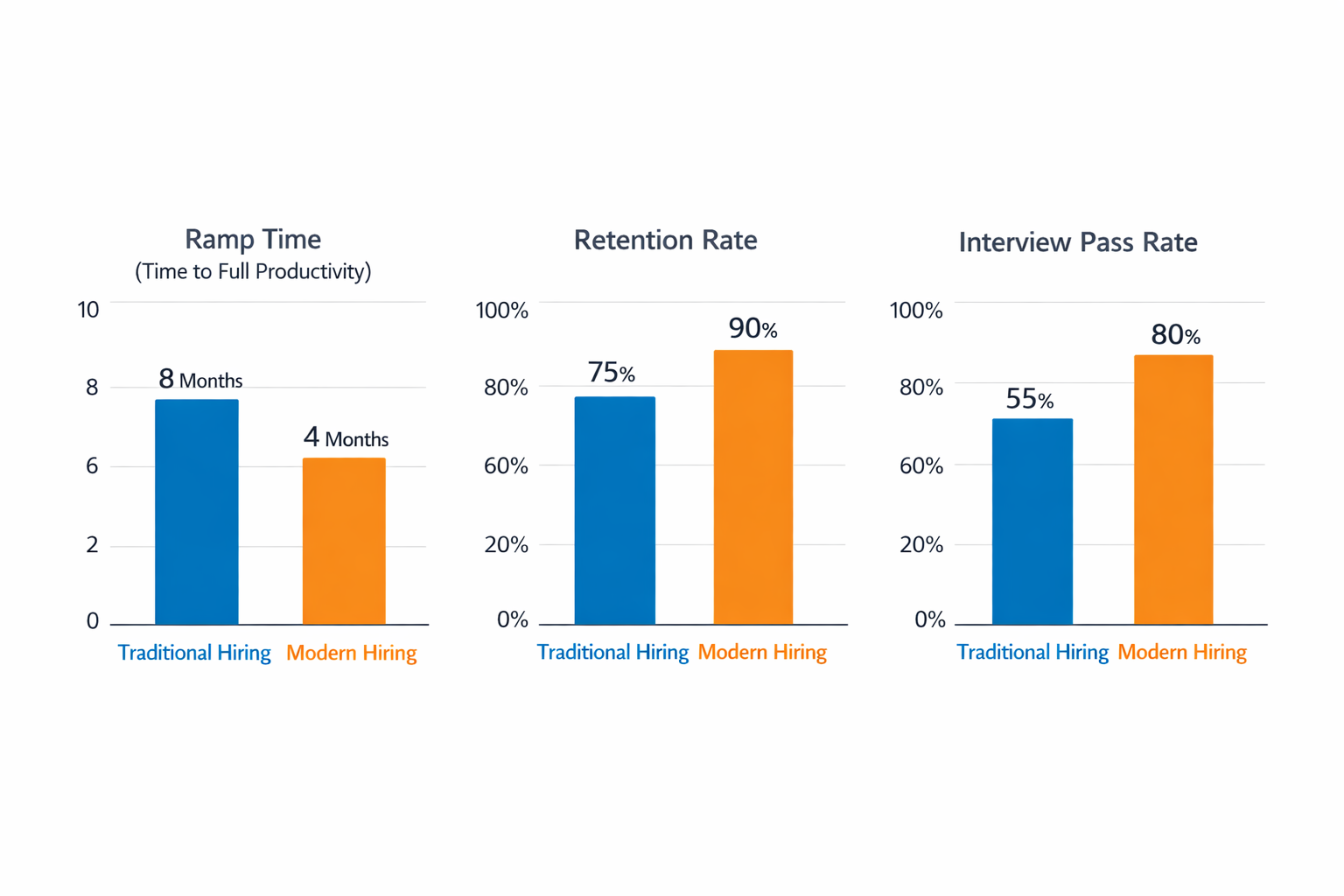
Retention is another essential metric. Early attrition often reveals mismatches in role clarity, management quality, or candidate expectations. If new hires leave within the first year, the hiring funnel may be accurately selecting talent but inaccurately setting expectations. That is a strategy failure, not just a recruiting problem.
Ramp time is especially useful in technical roles. How long does it take a new engineer to ship meaningful work independently? What resources accelerate that process? What parts of the system delay it? Measuring ramp time exposes onboarding gaps, documentation debt, and overcomplicated workflows. It also helps teams compare the effectiveness of different interview profiles and onboarding paths.
Team health should be included too. A team can hire strong individuals and still degrade if hiring increases coordination burden, introduces poor role fit, or creates management sprawl. Healthy teams show signs of sustainable delivery, manageable review load, low burnout, and good cross-functional trust. Hiring success is not just about the new person. It is about whether the team becomes stronger.
The most effective organizations build a dashboard that combines leading and lagging indicators: candidate quality, interview conversion rates, time-to-decision, offer acceptance rate, 90-day ramp, 12-month retention, internal mobility, and team health indicators. That data gives leaders a more honest view of whether their talent strategy is working.
8. Designing teams for AI-era delivery: pairing product thinking, platform thinking, and automation
AI changes not only how individuals work, but how teams should be structured. The most effective AI-era teams are not simply adding AI features on top of existing workflows. They are redesigning delivery around product thinking, platform thinking, and automation.
Product thinking ensures the team is solving the right problem. Engineers should understand the user, the business goal, and the success metric. AI can help generate faster solutions, but product thinking decides which solutions matter. Without it, teams risk shipping technically impressive features that do not move the product.
Platform thinking ensures the underlying systems are scalable, reusable, and safe. AI increases the value of strong platforms because automation multiplies both good and bad patterns. If developers have access to robust internal APIs, deployment tooling, observability, and standardized workflows, AI-assisted output can move faster with less risk. If the platform is weak, AI may accelerate inconsistency.
Automation is the force multiplier. It should reduce toil, standardize repetitive tasks, and create room for higher-level work. In AI-era delivery, automation can support test generation, code review assistance, incident summaries, documentation drafts, release notes, and support triage. But the organization still needs humans to define quality bars, review edge cases, and make consequential decisions.
This creates a new team design principle: optimize for leverage, not just headcount. A smaller team with strong product sense, a capable platform, and high automation maturity may outperform a larger team with fragmented responsibilities and manual workflows. The right structure encourages engineers to spend more time on architecture, user impact, and reliability—and less time on repetitive coordination.
For leaders, this means building teams around systems, not just roles. The question is not only “How many engineers do we need?” but “What combination of product fluency, platform maturity, and automation support will allow this team to ship reliably in the AI era?”
9. Common hiring mistakes tech companies still make, and how to avoid them
One common mistake is over-indexing on pedigree. Companies sometimes assume that school, brand-name employers, or polished interview performance are reliable proxies for on-the-job success. They are not. Strong hiring should focus on relevant evidence: past problem-solving, scope handled, collaboration style, and ability to learn.
Another mistake is writing job descriptions that are too broad. When every skill is required and every responsibility is listed, the role becomes unapproachable. Candidates either self-select out or enter with false expectations. A better approach is to separate must-have skills from growth areas and to describe the actual problems the hire will solve in the first six months.
A third mistake is using interviews that reward performance over substance. Some candidates are naturally good at conventional interview formats even if they are weaker in real-world execution. Meanwhile, excellent engineers may underperform in artificial settings. Structured, role-relevant assessments reduce that mismatch.
Teams also make the mistake of treating employer brand as a cosmetic exercise. Brand is not the logo, the swag, or the social media tone. It is the accumulated credibility of the organization. If employees are burned out, managers are inconsistent, or technical decisions are opaque, candidates will eventually find out. Authenticity scales better than polish.
A fifth mistake is neglecting the post-hire experience. If onboarding is weak, managers are unavailable, or career growth is unclear, the company pays for hiring twice. New hires who leave early are expensive not only in replacement cost, but in momentum lost.
Finally, some companies fail to adapt to AI as a hiring and operating reality. They either ignore AI entirely or assume it eliminates the need for depth. Both mistakes are costly. The right approach is to assess how candidates use AI responsibly, how teams govern quality, and how the organization integrates AI into its delivery model without lowering standards.
Avoiding these mistakes requires discipline. It means using data, listening to candidates, calibrating hiring managers, and continuously refining the process. Hiring is not a static function. It is an evolving system that must keep up with the way work actually happens.
10. A practical framework for building a team candidates want to join and employees want to stay on
A durable talent strategy in the AI era can be built around five practical layers: positioning, evaluation, onboarding, growth, and measurement.
First, positioning. Define what makes the team worth joining. Be specific about the problems, the stack, the decision-making style, and the kinds of engineers who thrive there. Avoid vague employer branding. Replace it with evidence: real artifacts, clear narratives, and honest tradeoffs.
Second, evaluation. Use structured, role-relevant interviews that test the skills the job actually requires. Reduce process length, remove duplicate interviews, and make scoring criteria explicit. Wherever possible, use work samples or realistic problem-solving instead of abstract puzzles. Evaluate not just code, but reasoning, collaboration, and judgment.
Third, onboarding. Give every new hire a path to contribution. Clarify expectations, provide documentation, assign mentors, and define early success milestones. In AI-enabled teams, onboarding should include the tools, workflows, and standards that govern how AI is used safely and effectively.
Fourth, growth. Make the career path visible. Support technical and managerial tracks, encourage mentorship, and create opportunities for internal mobility. Employees stay when they can imagine a future. That future should include deeper ownership, broader influence, and meaningful learning.
Fifth, measurement. Track the metrics that matter: quality of hire, retention, ramp time, offer acceptance, and team health. Use the data to improve the hiring funnel, the onboarding process, and the management system. Measure outcomes at the team level, not just the recruiting funnel.
This framework works because it treats talent as a system, not a transaction. Candidates are not only evaluating compensation and titles; they are evaluating whether the organization has the maturity to support excellent work. Employees are not only staying for the next raise; they are staying for clarity, growth, trust, and technical momentum.
The companies that win in the AI era will be the ones that understand a simple truth: hiring is not separate from engineering. It is part of engineering. The same discipline used to build reliable products should be used to build reliable teams.
Conclusion
The era of relying on a polished careers page and a standard interview loop is over. Modern tech teams need a talent strategy that reflects how software is actually built now: faster, more collaborative, more distributed, and increasingly shaped by AI.
The strongest companies will attract candidates by being specific and credible, evaluate them with fair and predictive methods, and retain them by investing in onboarding, mentorship, and internal mobility. They will treat culture as observable behavior, not branding. They will measure hiring by outcomes, not vanity metrics. And they will design teams around leverage, pairing product thinking, platform thinking, and automation to move faster without sacrificing quality.
In the AI era, talent strategy is not a separate HR concern. It is a core part of technical execution. Teams that understand this will not just hire better—they will build better organizations.