
Beyond the Org Chart: What Modern Tech Leadership Really Looks Like
Technology leadership has changed fundamentally. The old model—where success was measured by how efficiently teams shipped features, how cleanly reporting lines were drawn, or how well engineering stayed “in its lane”—is no longer sufficient. In a world defined by AI acceleration, platform dependency, cyber risk, distributed work, and tighter scrutiny from boards and customers, leaders in technology organizations are now expected to shape business strategy, operational resilience, and product direction at the same time.
This shift matters because technology is no longer a support function sitting behind the business. It is the business. The quality of the digital experience often determines retention. The architecture determines speed. The data strategy determines decision quality. The security posture determines trust. And the ability to adopt AI safely and effectively is becoming a major differentiator across industries. In this environment, modern tech leaders must do far more than manage delivery. They must build adaptable systems, align diverse stakeholders, and make tradeoffs that compound over time.
The org chart still has value, but it is no longer the center of gravity. Leadership now depends on influence, clarity, governance, and the ability to create environments where teams can execute with autonomy while remaining accountable to shared outcomes. The best leaders are not just operators. They are translators, architects, and catalysts. They connect technical depth to commercial outcomes, short-term execution to long-term resilience, and internal capability to external value.
1. Why Technology Leadership Now Matters More Than Ever
Technology leadership matters more today because the stakes are higher and the feedback loops are faster. A poor product decision can affect millions of users in hours. A weak security decision can become a public incident in minutes. A delayed platform investment can slow the entire company for quarters. The scope of impact has expanded, and so has the visibility of leadership decisions.
Modern executives are also operating in an environment where technology choices have direct financial consequences. Infrastructure costs, cloud optimization, AI tooling, and software delivery efficiency all affect margin. At the same time, customer expectations are rising. Users now compare every digital interaction not just with competitors, but with the best consumer-grade experiences available anywhere. That means technology leaders must shape experiences that are fast, reliable, intuitive, and differentiated.
There is also a governance dimension. Boards and executive teams increasingly expect technology leaders to articulate risk in business terms, explain investment priorities, and show how technical decisions support enterprise strategy. That requires more than engineering credibility. It requires strategic fluency, communication skill, and the ability to make the invisible visible. Leaders must describe why architecture matters, why technical debt matters, and why operational resilience matters in terms that non-technical stakeholders can act on.
Perhaps most importantly, technology leadership now has a culture-setting role. The leadership team determines whether the organization sees change as a threat or a capability. It determines whether teams hoard knowledge or share it, whether they optimize locally or systemically, and whether innovation is treated as a side project or a disciplined part of the operating model. In other words, leadership determines not just what gets built, but how the organization learns to build.
2. The Shift from Delivery Teams to Strategic Business Partners
For years, many technology groups were structured around a service mindset: the business asks, technology delivers. That model worked when technology was mostly an internal utility. It breaks down when technology becomes a primary source of competitive advantage. The modern expectation is not that engineering simply “takes tickets,” but that it participates in identifying opportunities, framing options, and shaping outcomes.
This shift changes the role of leaders at every level. Product and engineering leaders must understand the business model deeply enough to challenge assumptions and propose better ways to create value. They should be able to discuss customer acquisition, retention, unit economics, operational throughput, and regulatory constraints, not as afterthoughts but as design inputs. They also need to translate business goals into technical investments with clear tradeoffs, rather than waiting for requirements to be handed down fully formed.
Strategic partnership also changes planning. Instead of annual plans built around static roadmaps, modern tech organizations need dynamic portfolio management. They must balance innovation, maintenance, compliance, and scalability. That means making explicit choices about where to standardize, where to customize, and where to defer. The role of leadership is to create a decision framework that makes those tradeoffs visible and repeatable.
A strategic partner does not say yes to everything. It says, “Here are the options, the implications, and the risks.” That is a different kind of credibility. It requires teams to be close enough to the business to understand its pressures, but independent enough to recommend better paths. The strongest technology leaders create this tension productively. They move from being delivery managers to business designers.
3. Why AI Fluency Is Becoming a Core Leadership Requirement
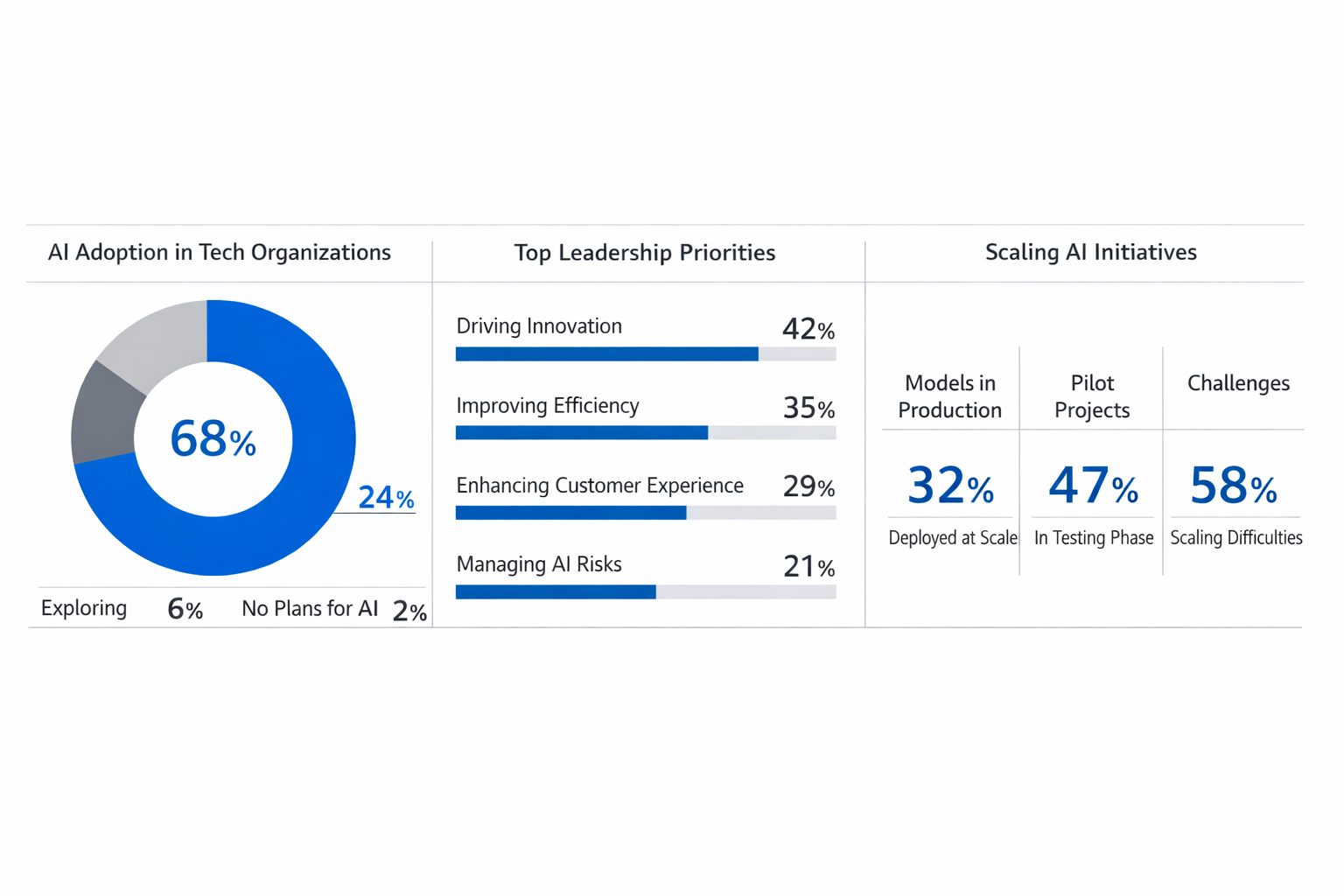
AI fluency is rapidly becoming a basic requirement for technology leaders because AI is no longer a niche capability. It is reshaping software development, support, analytics, customer service, personalization, forecasting, and decision support. Leaders do not need to become machine learning researchers, but they do need to understand what AI can do well, what it cannot do reliably, and what organizational changes are required to use it responsibly.
AI fluency has several layers. First is conceptual understanding: knowing the difference between predictive models, generative models, retrieval-augmented systems, and agentic workflows. Second is operational understanding: knowing the data, governance, security, and lifecycle requirements for deploying AI in production. Third is economic understanding: knowing where AI creates leverage, where it increases cost, and where it introduces hidden complexity. Fourth is leadership judgment: knowing when AI should be adopted, when it should be constrained, and when the right answer is not automation but better process design.
This matters because many organizations are rushing into AI with unrealistic expectations. Some expect immediate productivity gains without changing workflows. Others underestimate the cost of data preparation, model monitoring, human oversight, and integration with existing systems. Leaders who lack AI fluency are more vulnerable to hype, vendor pressure, and poor prioritization. Leaders who have it can distinguish between experiments that create learning and investments that create durable advantage.
AI fluency is also becoming a trust issue. Employees want to know how AI will affect their work. Customers want to know how their data is used. Regulators want transparency and accountability. Boards want to know the enterprise risk. Modern tech leaders must therefore communicate not only what AI can do, but how the organization will govern its use. That means setting policies, defining review processes, building human-in-the-loop safeguards, and ensuring that AI adoption supports the company’s values rather than undermining them.
4. Building an Organization That Scales Without Losing Accountability
Scaling is often mistaken for adding headcount. In reality, scaling is about increasing the organization’s ability to produce reliable outcomes without proportional increases in coordination cost. That requires clarity in roles, decision rights, operating cadences, and measures of success. Without those elements, growth creates confusion instead of leverage.
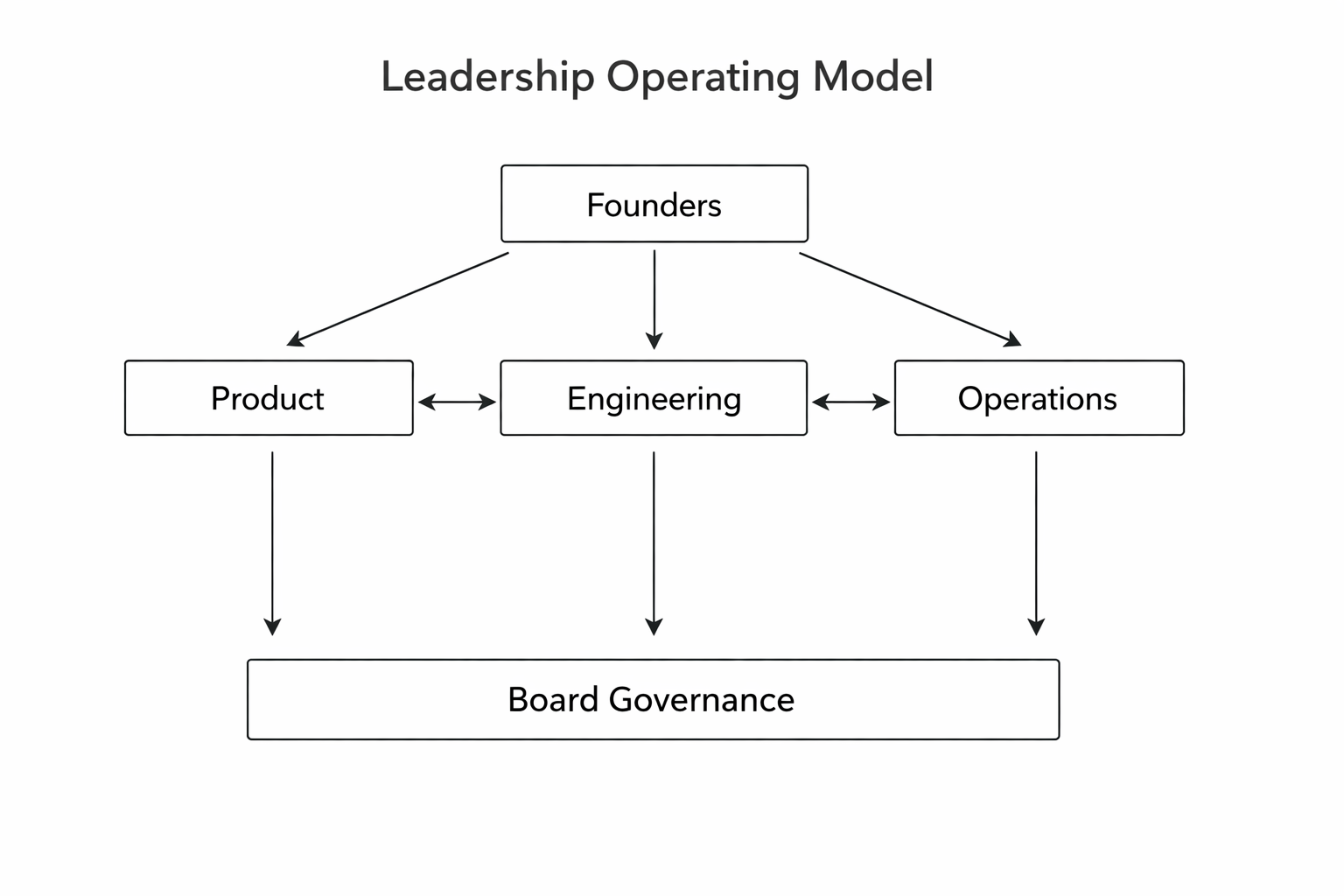
One of the biggest challenges in scaling is preserving accountability while increasing autonomy. As organizations grow, leaders can no longer make every decision directly. But if decision-making is delegated without structure, teams drift, priorities conflict, and ownership becomes blurry. The answer is not more hierarchy. It is better systems. Effective organizations define who decides what, who is consulted, who executes, and how outcomes are measured. They make accountability visible, not personal.
This is where operating models matter. Strong tech organizations often establish clear domains, platform boundaries, service ownership, and escalation paths. They reduce ambiguity by designing around products, capabilities, or value streams rather than only around functions. That makes it easier for teams to understand their responsibilities and for leaders to track performance across the system. It also reduces the tendency for work to get stuck between departments.
Scaling without losing accountability also depends on rituals. Quarterly planning, architecture reviews, incident postmortems, and business reviews should not be ceremonial. They should be mechanisms for learning, alignment, and decision-making. Leaders need a consistent way to see where commitments are slipping, where dependencies are accumulating, and where the organization needs intervention. The best leaders use these rituals to reinforce ownership rather than micromanage execution.
Finally, accountability must be paired with psychological safety. People cannot own outcomes if they are punished for surfacing problems early. A scalable organization encourages transparency about risk, misses, and uncertainty. That does not mean lowering standards. It means creating a culture in which people can report reality quickly enough to respond to it.
5. The Role of Governance, Board Alignment, and Succession Planning
Modern tech leadership is not only about execution inside the company. It is also about governance above it. Boards and executive teams need confidence that technology strategy is aligned with enterprise strategy, risk appetite, and long-term value creation. That requires technology leaders to operate with a governance mindset: structured, evidence-based, and transparent.
Governance in this context is not about bureaucracy. It is about decision quality. Strong governance ensures that the company knows which investments are strategic, which are operational necessities, and which are simply cost of doing business. It creates visibility into risk areas such as cyber resilience, vendor concentration, data quality, technical debt, and business continuity. It also provides a mechanism to escalate issues early, before they become operational or reputational crises.
Board alignment is especially important because technology initiatives often require patience. Infrastructure modernization, platform consolidation, identity management, and AI governance may not produce immediate revenue, but they can unlock long-term speed, resilience, and innovation. Leaders need to frame these investments in terms of business outcomes, not technical preferences. The board does not need implementation detail; it needs strategic clarity. What risk is being reduced? What capability is being created? What opportunity is being enabled?
Succession planning is another area where many organizations underinvest. Tech leadership roles are increasingly complex, and the loss of a single senior leader can create instability if institutional knowledge is concentrated. Modern organizations should treat succession as a capability, not an emergency response. That means building bench strength, rotating high-potential leaders through different domains, and ensuring that critical knowledge is documented and distributed.
It also means thinking beyond individual replacement. The question is not just “Who could fill this role?” but “How would the organization continue to function if this leader were unavailable?” That mindset forces leaders to design systems that are robust, repeatable, and not overly dependent on heroics. Good governance and succession planning are both forms of resilience.
6. How Customer Outcomes Should Shape Product and Engineering Priorities
Modern technology organizations often claim to be customer-centric, but many still organize work around internal systems, departmental goals, or feature throughput. A truly customer-centered organization starts with outcomes, not outputs. The relevant question is not how many stories were completed, but whether the customer’s experience improved in a meaningful way.
Customer outcomes should influence every layer of product and engineering prioritization. At the product level, this means choosing problems based on customer value, not internal convenience. At the engineering level, it means designing for usability, performance, reliability, and maintainability because those qualities shape the lived experience of the product. At the leadership level, it means measuring whether teams are reducing friction, increasing trust, and enabling customers to do the job they came to do.
This requires leaders to build better feedback loops. Usage analytics, NPS data, support tickets, churn reasons, customer interviews, and sales feedback should all inform prioritization. But data alone is not enough. Leaders need to interpret signals in context. A feature that is heavily used may still create confusion. A low-usage capability may be critical for a high-value segment. Customer outcome thinking requires judgment, not just dashboards.
The most mature organizations also connect customer outcomes to technical investment. If reliability affects renewal rates, then site reliability is not an internal engineering concern—it is a growth lever. If onboarding friction slows activation, then architecture decisions affecting latency, identity, or integration directly influence revenue. This is how technology leaders move from a support mindset to a value-creation mindset. They show that technical quality and customer success are not separate goals but interdependent ones.
7. The Importance of Culture: Speed, Learning, and Cross-Functional Collaboration
Culture is often described in vague terms, but in practice it is the collection of behaviors that shape how quickly and effectively work gets done. For modern tech leadership, the most important cultural attributes are speed, learning, and collaboration. Speed without learning creates repeated mistakes. Learning without speed creates stagnation. Collaboration without clarity creates noise. The goal is to build a culture that balances all three.
Speed matters because markets move quickly and customer expectations move even faster. But speed is not achieved by asking people to work longer hours. It is achieved by reducing friction: clear priorities, fewer handoffs, simpler approval paths, and better tooling. Leaders should look for ways to shorten feedback loops and remove unnecessary dependencies. The faster a team can see the consequences of its decisions, the faster it can improve.
Learning matters because no modern technology organization has perfect information. Mistakes are inevitable, but repeated mistakes are optional. Leaders should normalize postmortems, retrospectives, experiments, and pilot programs. They should reward teams for surfacing problems early and for updating their views based on evidence. A learning culture does not confuse adaptability with indecision. It uses information to become more decisive over time.
Cross-functional collaboration matters because most meaningful outcomes require multiple disciplines. Product, engineering, design, security, data, operations, and customer-facing functions must work together if the organization is to deliver coherent experiences. Leaders must create shared language and shared goals so these groups do not optimize in isolation. When collaboration is strong, teams spend less time negotiating boundaries and more time solving problems.
Culture is ultimately the invisible infrastructure of performance. Teams can inherit tools, systems, and budgets, but they cannot inherit trust, curiosity, or discipline. Those must be designed and reinforced by leadership through daily behavior.
8. Measuring Leadership Success Beyond Revenue: Trust, Resilience, and Adoption
Revenue matters, but it is not enough as a measure of technology leadership. A team can drive short-term revenue while accumulating risk, eroding trust, or creating future fragility. Modern leaders need a broader scorecard that captures whether the organization is becoming stronger over time.
Trust is one of the most important metrics, even if it is difficult to quantify. Trust shows up in how reliably teams deliver, how honestly they communicate, how confidently customers use the product, and how much confidence the board has in leadership judgment. Trust can be measured indirectly through customer satisfaction, employee engagement, incident response quality, and stakeholder feedback. Leaders should treat trust as an asset that can be built or damaged.
Resilience is another critical measure. Resilience includes system uptime, recovery time, incident frequency, redundancy, and the ability to continue operating under stress. But it also includes organizational resilience: whether the company can absorb turnover, absorb market shifts, and absorb new technology demands without losing effectiveness. A resilient technology organization does not avoid disruption. It can respond to it without collapsing into chaos.
Adoption is equally important, especially in the context of internal platforms, new products, and AI-enabled tools. A feature that is technically elegant but rarely used is not creating much value. Adoption metrics tell leaders whether the organization has solved a real problem or merely produced an output. For internal technology, adoption also reveals whether teams trust the tool, find it usable, and see it as part of their workflow rather than an imposed burden.
A modern leadership scorecard should therefore include measures such as customer retention, platform reliability, deployment frequency, incident recovery, employee retention, data quality, AI adoption, and cross-functional satisfaction. The point is not to overload leaders with metrics. The point is to reflect the true system, not just the financial result. Strong leadership creates durable conditions for success, and those conditions should be visible in the metrics.
9. What the Next Generation of Tech Leaders Needs to Do Differently
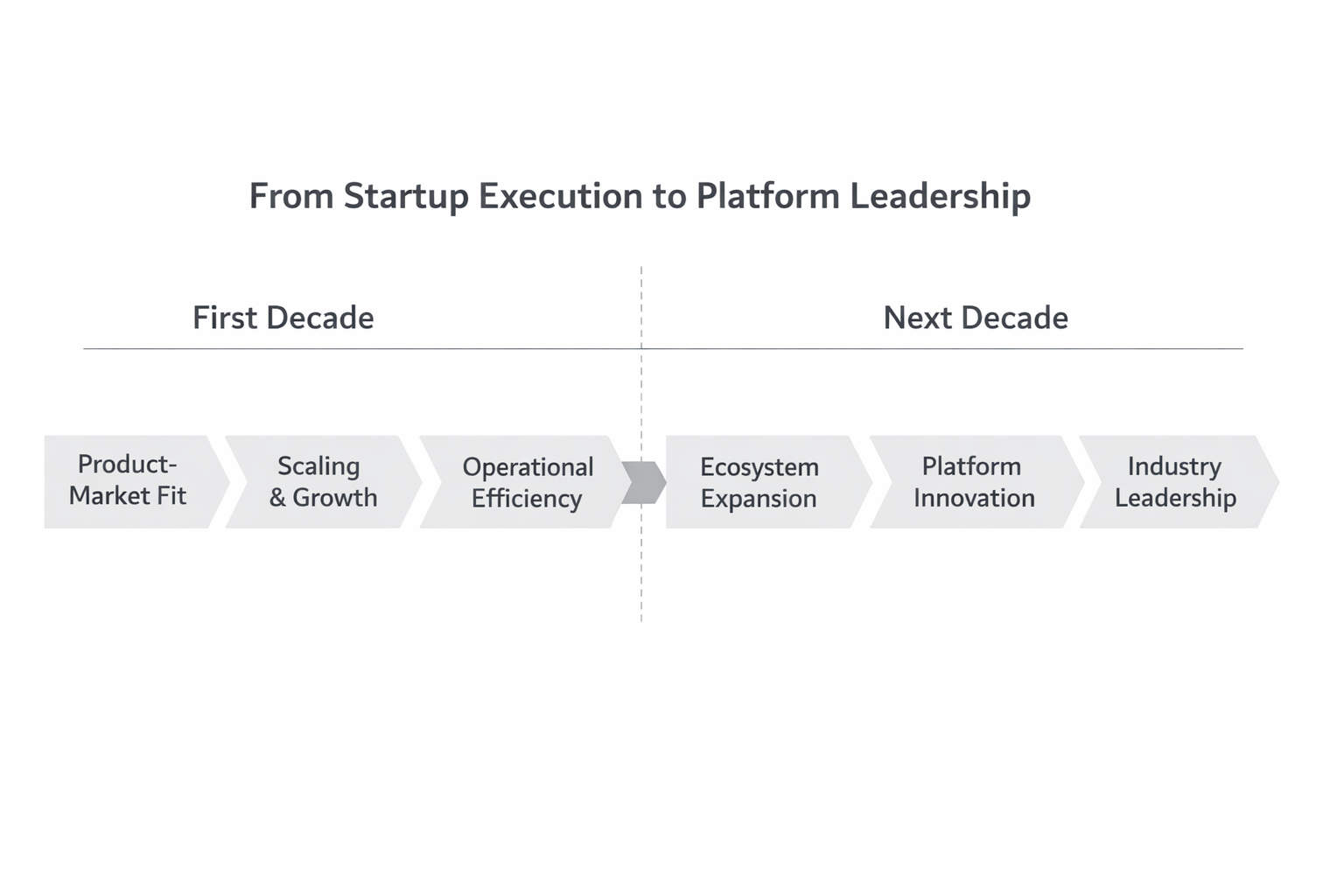
The next generation of tech leaders will not succeed by copying the habits of the last generation. The environment has changed too much. They will need broader business literacy, stronger communication skills, deeper systems thinking, and greater comfort with ambiguity. They will need to lead through influence more often than authority, because modern organizations are flatter, more distributed, and more interconnected than before.
One major difference is that future leaders must become fluent in managing ecosystems, not just teams. Much of modern technology value comes from platforms, partners, APIs, data flows, and external dependencies. That means leaders need to think in terms of networks, not silos. They must understand where leverage comes from and where fragility hides. They should know how vendor strategy, open source, security posture, and interoperability affect long-term flexibility.
They also need to be more deliberate about talent development. The old model assumed that strong individual contributors would naturally become effective leaders. That is no longer enough. Leadership requires training, coaching, and reflection. Future leaders need to learn how to delegate effectively, build inclusive teams, communicate with precision, and make difficult tradeoffs without losing credibility. Organizations that invest in these skills will build stronger leadership pipelines.
Another difference is that next-generation leaders must integrate ethical judgment into everyday decision-making. AI, data use, automation, and platform design all raise questions about fairness, transparency, and responsibility. The best leaders will not treat ethics as a compliance issue that gets checked at the end. They will consider it part of design, governance, and customer trust from the beginning.
Most importantly, the next generation must think systemically. The best leaders will not ask, “How do I control more?” They will ask, “How do I create an environment where good outcomes happen consistently?” That shift—from control to system design—is one of the defining traits of modern leadership.
10. Conclusion: Leadership as a System, Not a Title
Modern tech leadership is no longer defined by position alone. The org chart may show who reports to whom, but it does not capture how decisions are made, how trust is built, or how the organization adapts under pressure. Real leadership is a system made up of strategic clarity, governance, accountability, culture, customer obsession, and operational discipline.
The strongest technology leaders understand that their job is not simply to direct work. It is to design conditions for sustained performance. They align technology with business strategy, make AI adoption responsible and practical, build organizations that scale without losing ownership, and measure success in terms that reflect long-term health, not just short-term output.
As technology continues to shape every part of the enterprise, leadership will matter more, not less. The organizations that win will be those led by people who can connect execution to strategy, speed to learning, and innovation to trust. In that sense, modern tech leadership is not about occupying a role. It is about creating a system that keeps producing value long after any single leader has moved on.