
How to Turn a Contact Page Into a High-Conversion Growth Engine
A contact page used to be the digital equivalent of a business card: a phone number, an email address, maybe a short form, and a polite “we’ll get back to you.” That model no longer matches how software buyers evaluate partners or how product teams initiate work. Today, a contact or consultation page is often the first real qualification moment in the buying journey. It can either create momentum or quietly leak demand.
For technology companies, agencies, consultancies, and product studios, the contact page has become a strategic asset. It’s where intent is captured, trust is established, and the first layer of discovery happens. In a market where AI has accelerated prototyping, reduced the cost of experimentation, and raised expectations for speed, a generic “contact us” form feels too slow, too vague, and too low-context for serious buyers. Users expect to understand what happens next, what kind of expertise they’re engaging, and whether the partner in front of them can actually deliver.
This shift matters because the opportunity is larger than simple lead generation. A well-designed consultation flow can improve lead quality, compress sales cycles, and create a more credible first impression before a salesperson ever joins the conversation. It can also help a company filter out mismatched projects without sounding dismissive. In other words, the contact page is no longer just a utility. It is part of the product, part of the brand, and part of the pipeline. Done well, it becomes a conversion engine that supports revenue growth rather than just inbound communication.
1. Why the old “contact us” page is no longer enough and what users expect instead
The traditional contact page was built for an era when buyers were willing to send a simple message and wait for a human to interpret it later. That assumption breaks down in modern B2B software and product services. Buyers are busier, comparison-shopping more aggressively, and more accustomed to guided digital experiences. They do not want to fill out a vague form and hope they hear back from the right person. They want immediate confidence that their inquiry will reach someone who understands their problem and can respond with relevance.
What users expect now is a structured pathway, not an open mailbox. They want to know whether they are asking for product design, engineering support, AI implementation, platform migration, or strategic advisory. They want to see signs that the company has done this before, understands their industry or stack, and can tailor the conversation to their context. They also want clarity about timelines, process, and next steps. If they submit a form, what happens next? Will they receive a scheduling link, a discovery questionnaire, a response within one business day, or a proposal request? Ambiguity creates friction.
There is also a trust component. A contact page that feels generic can make a specialized firm appear generic. If a company claims to build sophisticated software or AI systems, the contact experience should reflect that sophistication. This means useful segmentation, smart prompts, and evidence of how the engagement starts. The best pages now behave like intake systems. They help the visitor self-identify, reduce back-and-forth, and set expectations before the first call.

In practical terms, the shift is from “send us a message” to “help us route your request intelligently.” That can include service-specific pathways, project type selectors, budget indicators, and timeline questions. None of this should feel bureaucratic. The goal is not to create a barrier. The goal is to reduce uncertainty. The more precise the intake, the more likely the first response is useful, and the more likely the opportunity advances.
2. How AI has changed the way software and product teams discover, scope, and launch work
AI has transformed not only what teams build, but how they begin building. Discovery used to depend heavily on manual research, long workshops, and static documentation. Now teams can use AI systems to summarize research, draft requirements, generate prototypes, inspect code, accelerate testing, and surface implementation paths much earlier in the process. OpenAI’s current product direction makes this shift obvious: agents and coding tools are positioned to support workflow design, iterative development, code tasks, and evaluation in ways that compress the time between idea and execution. (openai.com)
For product and engineering teams, this changes the scoping conversation. A client may no longer be asking, “Can you build this from scratch?” They may be asking, “Can you help us determine whether this should be custom-built, partially automated, or augmented with an AI workflow?” They may already have a rough prototype generated through internal experimentation or an AI-assisted proof of concept. That means the first conversation is increasingly about fit, feasibility, and integration rather than raw capability.
AI also changes expectations around delivery. If a team can draft interfaces, generate boilerplate, inspect files, run commands in controlled environments, and produce iterative outputs faster, they will expect partners to move with similar speed and sophistication. OpenAI’s developer platform and AgentKit materials emphasize visual and code-first workflows, faster agent deployment, evaluation, and lower front-end effort, which reflects a broader industry trend toward faster software composition and orchestration. (openai.com)

The implication for a contact page is significant. It should not assume that the visitor needs education about basic technology services. Many visitors already know the category; they need help deciding whether your team can solve their specific version of the problem. That means the inquiry flow should ask more intelligent questions, acknowledge AI-native delivery patterns, and make it easy to start with the right level of specificity.
3. The real business problem clients are trying to solve: speed, clarity, and lower delivery risk
When a prospect fills out a consultation form, the stated request is often only the surface layer. Beneath it is a business problem that usually falls into three categories: speed, clarity, and delivery risk. They want the work done faster, they want confidence about what the engagement will produce, and they want to reduce the chance of wasting time or budget on the wrong approach.
Speed matters because product cycles are shorter and market windows are tighter. In software, a delay does not just postpone delivery; it can delay learning, competitiveness, fundraising milestones, customer acquisition, or operational efficiency. Teams increasingly use AI-enabled tools and agents to accelerate development, automate tasks, and reduce manual work because the market rewards shorter time-to-value. OpenAI’s materials repeatedly frame agents, coding systems, and automation as tools to reduce time spent on repetitive or complex work and to bring production outcomes forward. (openai.com)
Clarity is equally important. Many buyers are not looking for a vendor who can say yes to everything. They are looking for a partner who can turn vague business goals into a practical roadmap. That means translating “we need a better onboarding experience” into a well-scoped product problem: Which users? Which friction points? Which systems? Which success metrics? The first conversation is often where that clarity either emerges or collapses.
Delivery risk is the third and often most important issue. Clients worry about mismatched expectations, hidden complexity, integration problems, and partners who understate effort early only to expand scope later. That is why high-trust consultative experiences matter so much. The contact page should signal that the team understands implementation reality, not just surface-level strategy. It should communicate that the company knows where projects commonly fail and has a process for preventing that.
The best contact flows therefore function as early risk-reduction systems. They help the client feel understood, and they help the provider assess whether the project is a fit. When both sides gain confidence before the first call, sales conversations become more productive and delivery starts from a better foundation.
4. What makes a technology partner credible today: proof, process, and domain understanding
Credibility used to be framed mostly around portfolio logos and polished case studies. Those still matter, but they are no longer sufficient. Today’s buyers want three things: proof, process, and domain understanding.
Proof is evidence that the company has solved similar problems before. That can include case studies, technical writeups, measurable outcomes, architecture examples, product demos, or narrowly focused expertise pages. The strongest proof is not just “we built something,” but “we solved a problem like yours, under similar constraints, and achieved measurable results.” Credibility rises when proof is specific and operational rather than decorative.
Process is equally important. Buyers want to know how the work will unfold. What does discovery look like? How are requirements validated? How are prototypes reviewed? How do teams handle iteration, testing, and launch readiness? In AI-heavy delivery, process matters even more because teams need reliable ways to evaluate outputs, manage agent behavior, and ensure systems are safe and predictable. OpenAI’s guidance around agents emphasizes workflows, evaluation, controlled environments, and structured deployment as part of making agent systems production-ready. (openai.com)
Domain understanding is the third signal. A partner who understands healthcare, fintech, logistics, marketplaces, or internal enterprise software can frame questions better and avoid generic recommendations. Domain fluency shows up in the way a company talks about compliance, user roles, data flows, integrations, adoption patterns, and business constraints. Visitors should be able to tell quickly whether the team understands their world.
A strong contact page should surface all three signals. It can do this with targeted proof points near the form, a concise explanation of the engagement process, and examples of work by category or industry. It should also avoid overclaiming. Serious buyers can detect exaggeration quickly. Credibility today is less about sounding impressive and more about sounding precise.
5. Designing a stronger first conversation: questions that uncover product goals, constraints, and timelines
The first conversation is not just a scheduling event. It is a diagnostic step. A good inquiry form or consultation intake should help uncover the context needed to run a meaningful discovery call. The goal is not to interrogate the visitor, but to gather enough structure so the first human interaction can be useful.
A strong first conversation should explore four dimensions: the business goal, the user or customer problem, the technical or operational constraints, and the timeline. A form can start with broad prompts like “What are you trying to achieve?” and then progressively refine. For example: Is this about growth, efficiency, compliance, activation, retention, or internal productivity? Is the request about a new product, an enhancement, a migration, or an automation workflow? What systems does this need to connect with? What deadlines are driving the project?
Good questions help establish scope without overwhelming the visitor. For example:
What outcome would make this project a success?
What is the current blocker or inefficiency?
Who are the primary users or stakeholders?
What tools, platforms, or data sources are involved?
Do you already have a spec, prototype, or internal team?
What timeline are you working against?
Are there security, compliance, or procurement constraints?
These questions do more than collect information. They signal how the company thinks. They show that the team understands product delivery as a mix of strategy, systems, and execution. They also help visitors self-assess. Someone with a simple website update may route differently from a team seeking an AI-powered workflow or custom application.
The key is to make the conversation feel collaborative. The form should read like the start of a useful partnership, not a compliance exercise. A responsive consultation experience tells the user, “We know how to think about your problem, and we’re helping you get to the right next step.” That positioning dramatically improves the quality of inbound leads.
6. The rise of low-code, automation, and agentic AI in product delivery—and where human expertise still matters
Low-code, automation, and agentic AI have changed the economics of product delivery. Teams can now assemble workflows faster, connect systems with less hand-coding, and prototype ideas with far less upfront overhead. OpenAI’s recent platform updates reinforce this direction: AgentKit, the Agents SDK, and related developer tooling are designed to help teams build workflows, deploy interfaces, evaluate performance, and run agentic tasks in controlled environments. (openai.com)
This matters for service businesses because clients now assume faster exploration is possible. They may arrive expecting that an internal process can be automated, a support workflow can be agent-assisted, or a product feature can be prototyped rapidly using a blend of code and AI tools. They are not necessarily looking for a traditional “full build” in every case. They may want a smaller, smarter intervention: a workflow, an integration layer, a decision assistant, a data-enrichment system, or a narrowly scoped internal tool.
But speed does not eliminate the need for human expertise. In fact, it increases the need for judgment. AI can accelerate implementation, but it does not replace problem framing, architecture choices, tradeoff analysis, stakeholder alignment, or quality assurance. Teams still need humans to decide what should be automated, what should remain manual, what needs guardrails, and how to evaluate success. OpenAI’s own materials emphasize controlled workflows, evaluation, and production reliability, which underscores that agentic systems require design discipline, not just model access. (openai.com)
A high-conversion contact page should reflect this balance. It should position the company as a partner that can move quickly with modern tooling, but also as a group that knows where automation ends and product judgment begins. That combination is highly compelling to serious buyers because it suggests both innovation and control.
7. How to present services around outcomes rather than generic capabilities
Many technology websites still organize service offerings around abstract capabilities: “design,” “development,” “strategy,” “AI,” “automation,” “consulting.” Those categories may be internally convenient, but they are not always how buyers think. Buyers usually start from an outcome: reduce onboarding friction, launch a new product faster, automate a manual workflow, improve conversion, connect systems, or introduce AI safely into an existing process.
Presenting services around outcomes helps buyers self-identify faster. It shortens the mental translation layer between their problem and your offer. Instead of asking whether a visitor understands your capability list, you meet them at the level of business result. That reduces friction and improves conversion quality.
An outcomes-led structure can be organized in several ways:
By business goal: growth, efficiency, retention, operations, modernization.
By use case: internal tooling, customer-facing product, AI assistant, workflow automation, platform integration.
By stage: discovery, prototype, MVP, scale-up, optimization.
By complexity: advisory, implementation, augmentation, full delivery.
This approach also makes it easier to route inquiries. If someone selects “automate a recurring operations workflow,” the form can ask a different set of questions than if they select “design a customer-facing AI experience.” That creates relevance immediately.
Visual presentation matters too. Outcome-led service cards, short example scenarios, and proof points near each offering help visitors understand what engagement might look like. The page should answer not just “what do you do?” but “what problem does this solve?” When services are framed in outcome language, the contact page becomes a self-selection engine rather than a static directory.
8. Turning inquiry forms into qualification tools without making them feel impersonal
Qualification is essential, but it must be handled carefully. If a form feels like a gatekeeping mechanism, it can discourage good leads. If it is too shallow, it generates a flood of low-quality inquiries that slow the sales process. The best forms do both: they qualify and they reassure.
The first rule is progressive disclosure. Don’t ask for everything at once. Start with the minimum needed to understand intent, then reveal additional questions only when they become relevant. This keeps the experience lightweight while still allowing deeper qualification for higher-intent visitors. For example, budget questions might appear only after the user selects a project type. Timeline questions may be optional but encouraged. Technical stack questions can be tailored to the category selected.
The second rule is to explain why you’re asking. A small line of microcopy can make a big difference: “These details help us route your inquiry to the right specialist and recommend the best next step.” That framing turns a potentially intrusive question into a helpful one.
The third rule is to keep the tone human. Use language that feels conversational and supportive rather than transactional. Instead of “Please specify deliverables,” try “What are you hoping to accomplish?” Instead of “Select your budget range,” try “What investment range are you planning for this work?” Language shapes perception, and perception shapes trust.
The fourth rule is to make the form feel responsive. If a visitor selects “AI workflow,” the form should adapt. If they choose “urgent timeline,” the confirmation should acknowledge urgency. If they are a returning customer, the form should recognize that context and reduce repetition where possible. That sense of intelligence is now part of the user experience.
A qualification form should therefore act like a guided conversation, not an intake wall. Done well, it improves lead quality while making the visitor feel understood from the first interaction.
9. A simple framework for responsive, high-trust consultation experiences
A high-trust consultation flow is built on five steps: clarify, qualify, reassure, route, and respond.
Clarify the purpose of the page immediately. The visitor should know whether they are starting a project, requesting a consultation, or exploring a specific service. The headline, supporting copy, and visual hierarchy should all reinforce this. If the page is meant for serious buyers, say so clearly.
Qualify with focused questions that reveal the shape of the opportunity. Ask enough to understand the problem, but not so much that you create friction. Use conditional logic to adapt the form to the visitor’s intent. Ask what outcome they want, what constraint they face, what systems are involved, and what timing matters.
Reassure with visible proof and process. Place concise case studies, client types, technical strengths, or delivery steps near the form. Buyers need to know that a real team is on the other side and that their submission won’t disappear into a black box.
Route the inquiry intelligently. Make sure the right team member, specialist, or business line receives the request. A form that ends in generic inbox chaos defeats the purpose. Smart routing improves response quality and reduces delay.
Respond fast and with relevance. The confirmation email or follow-up message should not be a placeholder. It should acknowledge the inquiry, confirm next steps, and ideally add value immediately. For example, it might include a scheduling link, a short overview of the process, or a request for a key artifact such as a brief, prototype, or architecture diagram.
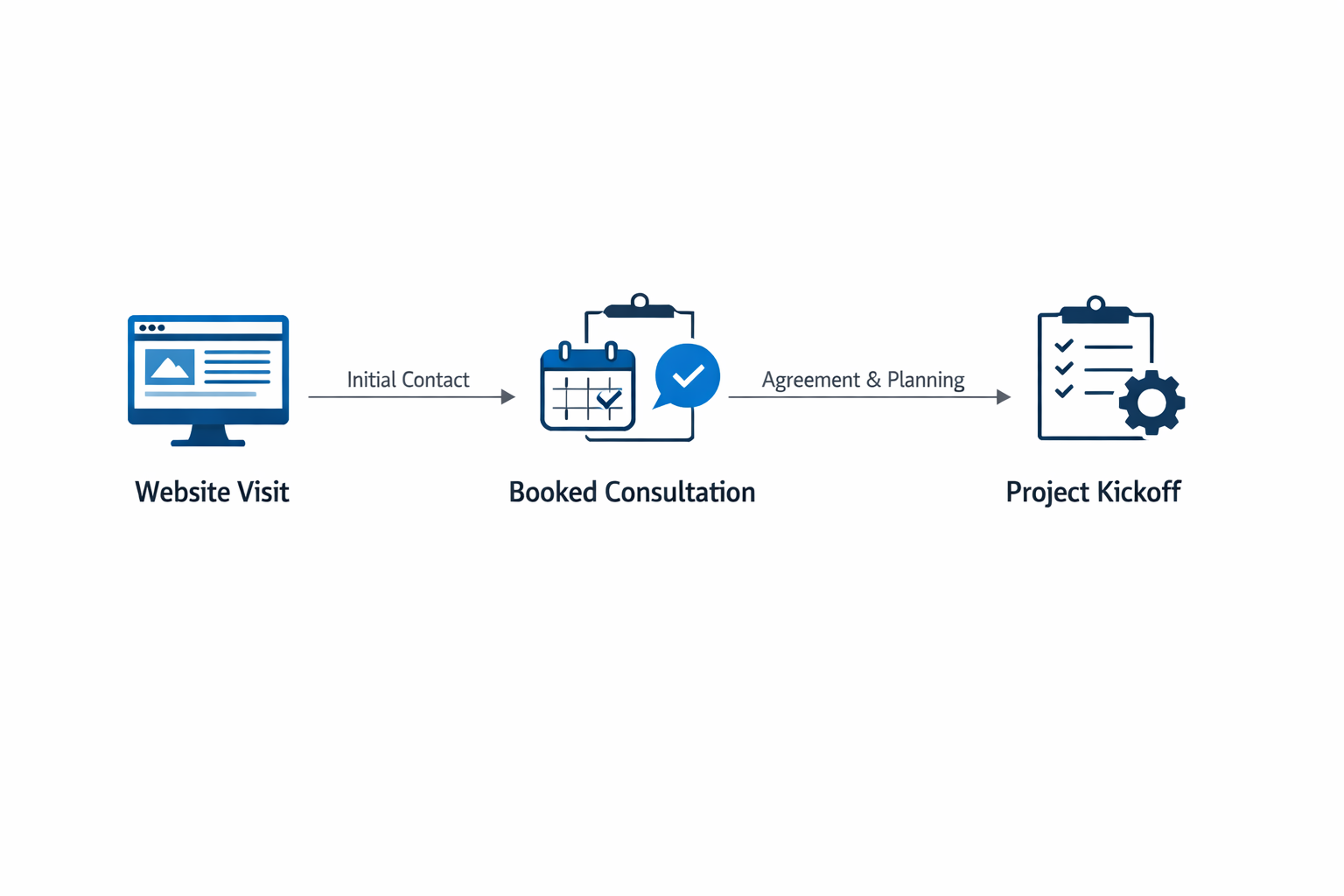
This framework is simple, but it is powerful because it aligns user experience, sales operations, and delivery readiness. A consultation flow is high-trust when the visitor feels seen, the company feels organized, and the next step feels obvious.
10. How to measure whether your contact and consultation flow is actually generating pipeline
A contact page should not be measured only by submission volume. That is one of the most common mistakes in lead-generation optimization. More submissions are not always better if the leads are unqualified, mismatched, or impossible to close. The real question is whether the contact flow is generating pipeline.
Start by measuring conversion at multiple stages. Track page visits to form starts, form starts to form completions, form completions to qualified meetings, meetings to proposals, and proposals to closed opportunities. A healthy contact flow should improve not just the top of the funnel, but the quality of progression through the funnel. If form completions rise but qualified meetings fall, the form may be too broad. If completions drop sharply, the form may be too complex or too opaque.
Measure lead quality by source and intent. Which service pages, content pieces, or campaign paths create the best inquiries? Which options in the form correlate with stronger opportunities? Which industries, project types, or budget ranges close more often? These patterns help you refine both the page content and the routing logic.
Also measure responsiveness. Time to first response is a major signal of operational discipline. The faster and more relevant the first reply, the better the chance of keeping momentum. Monitor whether leads who receive a tailored response convert better than those who receive a generic acknowledgement. In most cases, the answer will be yes.
At the business level, tie the page to pipeline metrics: qualified opportunity value, win rate, sales cycle length, and revenue influenced. The contact page is not just a front-end asset; it is part of the revenue system. If you treat it as a conversion surface rather than a form, you can test wording, structure, routing, proof points, and qualification logic with the same rigor you would apply to any other growth channel.
Conclusion
The modern contact page is no longer a passive endpoint. It is a strategic conversion layer that shapes perception, qualifies demand, and accelerates sales. In a market where AI has changed how teams discover, scope, and build software, buyers expect more than a generic mailbox. They expect clarity, speed, proof, and a process that feels intelligent.
The strongest consultation experiences do four things well. They help visitors articulate the problem. They communicate credibility through proof and domain understanding. They use qualification to improve fit without creating friction. And they turn the first interaction into a meaningful step in the sales process.
For technology teams, this is a major opportunity. By redesigning the contact page around outcomes, trust, and responsiveness, you can transform it from a neglected utility into a high-conversion growth engine. The companies that win this layer of the experience will generate better leads, faster decisions, and stronger pipeline.